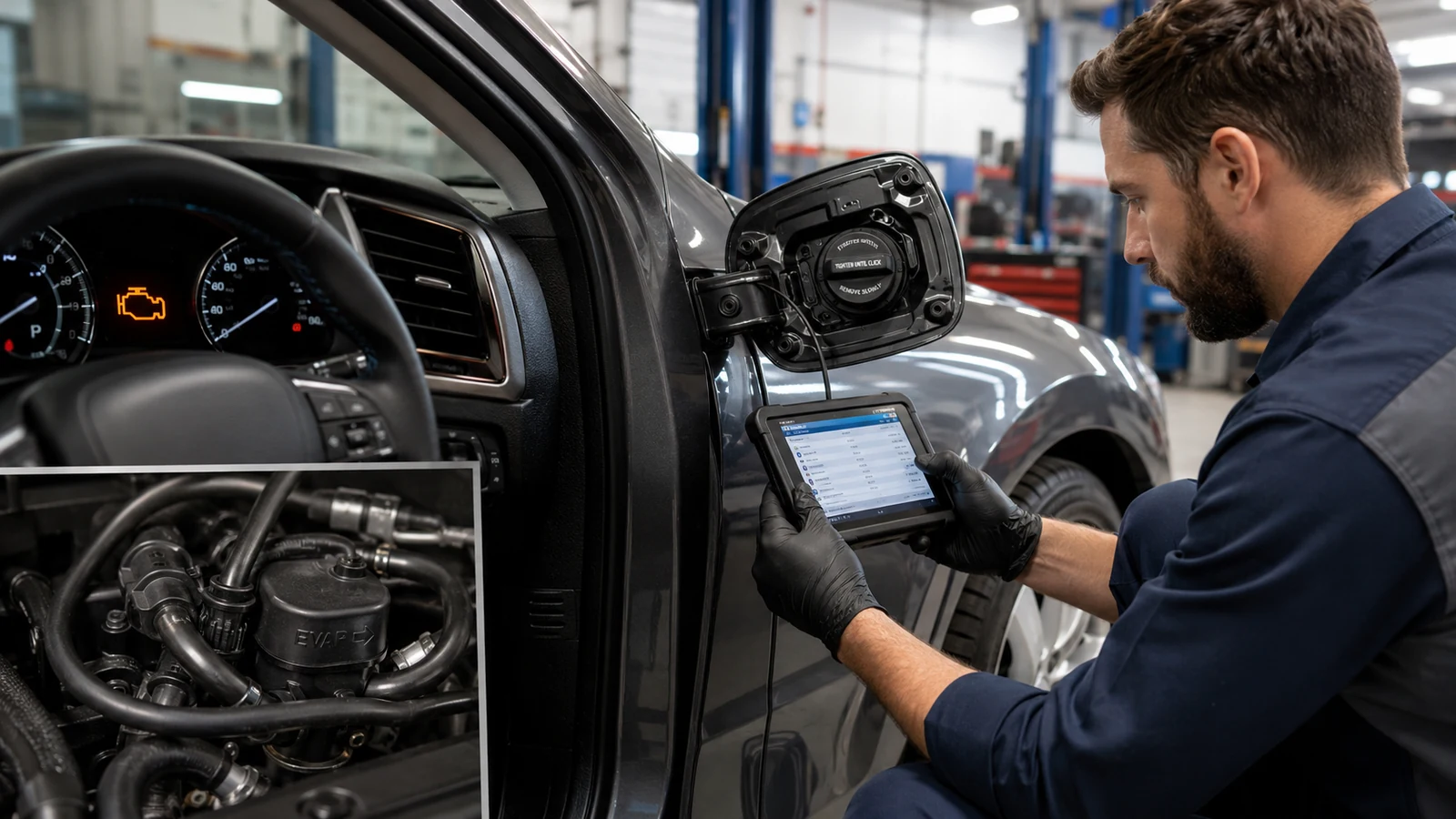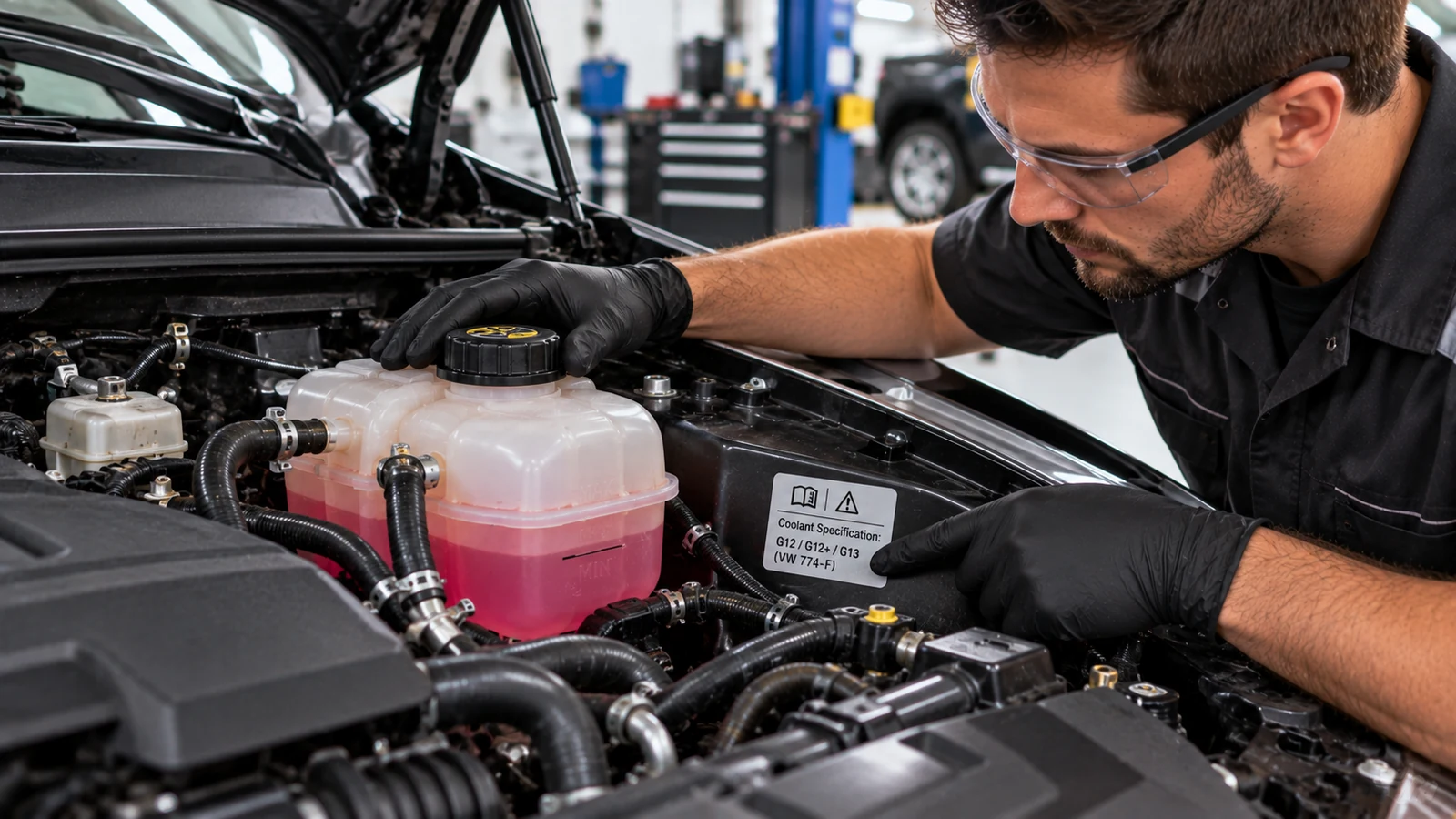
The safest antifreeze for your car is the coolant that meets the manufacturer’s required specification for your exact model, model year, and engine.
Don’t choose coolant just because the liquid already in the reservoir is green, orange, pink, blue, or another familiar color. Coolant dye isn’t standardized across manufacturers and aftermarket brands.
What matters most is the underlying chemistry and OEM specification.
Using an incompatible coolant can reduce corrosion protection and may create deposits or sludge that restrict flow through the radiator, heater core, and smaller cooling passages. It can also contribute to water pump, gasket, and cooling-system problems.
If you are unsure, check the owner’s manual or vehicle-specific factory service information before adding anything.
The Quick Way to Choose the Correct Antifreeze
Before buying coolant, check these four things:
- Your vehicle’s model year and engine
- The OEM coolant specification
- The required coolant chemistry
- Whether the bottle is concentrate or pre-mixed 50/50
Color can help you recognize a coolant you already know, but it should not be the deciding factor.
For example, two coolants may both be blue while using different additive packages. At the same time, two products with similar chemistry may be dyed different colors by different manufacturers.
The specification printed on the bottle is much more useful than its appearance.
Antifreeze vs. Coolant: What Is the Difference?
The terms antifreeze and coolant are often used interchangeably, but there is a practical distinction.
Antifreeze concentrate contains the glycol base and corrosion-inhibiting additive package but normally needs to be mixed with water before use.
Engine coolant commonly refers to the finished mixture circulating through the vehicle’s cooling system.
Most passenger vehicles use coolant based on either ethylene glycol or propylene glycol combined with corrosion inhibitors and water.
The additive package matters because a modern cooling system includes several materials that need protection, including aluminum, iron, seals, gaskets, radiator components, and water pump parts.
The Main Types of Automotive Coolant
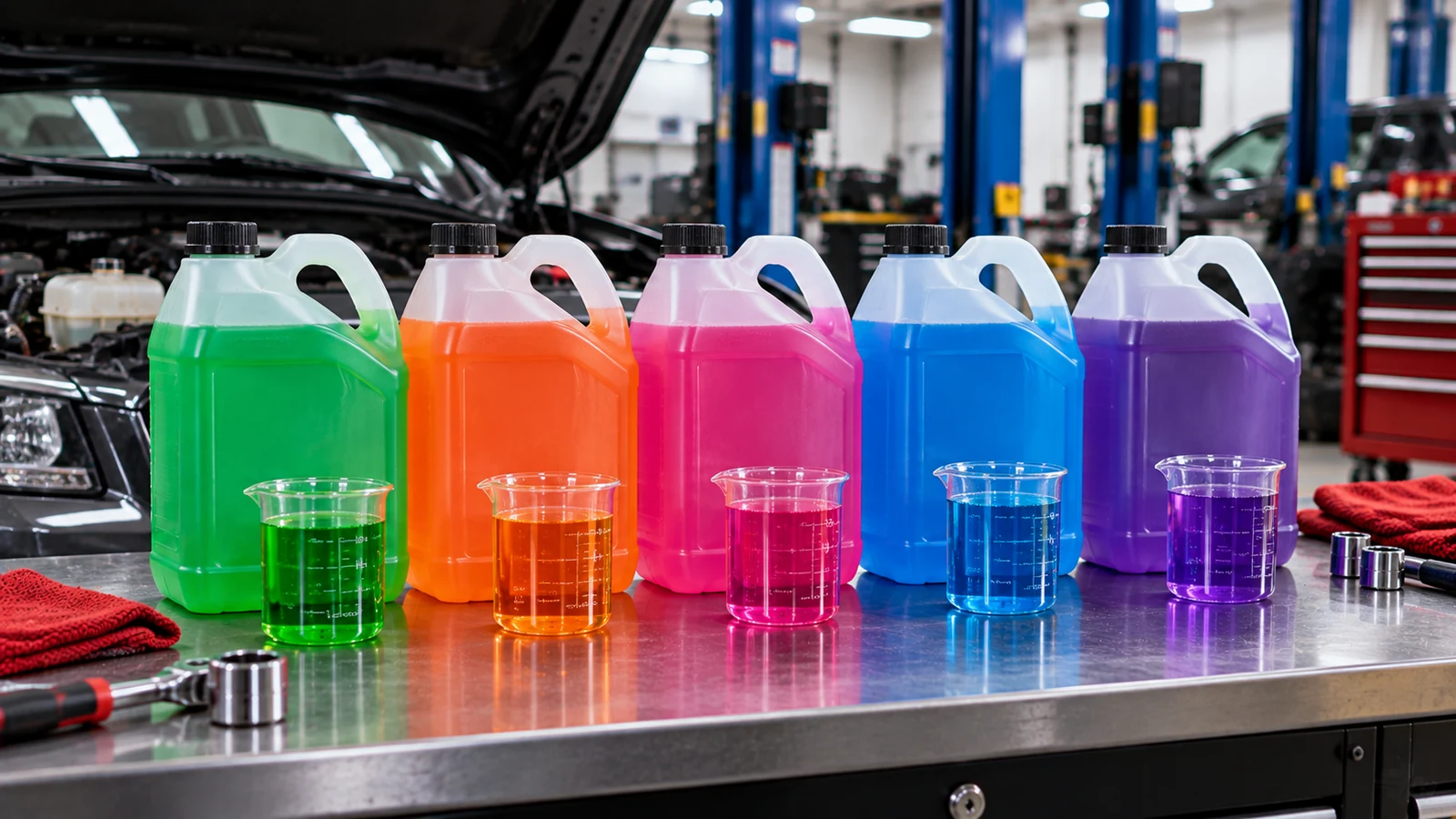
Coolant technology has changed as engine materials, service intervals, and cooling-system designs have evolved.
Here is a practical comparison of the main chemistries.
| Coolant Type | Common Colors* | General Technology | Typical Service Life | Common Applications |
|---|---|---|---|---|
| IAT | Green | Silicates and phosphates | About 2 years / 30,000 miles | Many older vehicles |
| OAT | Orange, red, pink | Organic acid inhibitors | Up to 5 years / 150,000 miles | Many GM, Ford, and European applications |
| HOAT | Yellow, gold, turquoise | Organic acids plus inorganic inhibitors | Around 5 years / 100,000 miles | Various Ford, Chrysler, Jeep, and European vehicles |
| P-HOAT | Blue, pink | Organic acids plus phosphates | Around 5 years / 120,000 miles | Common in Asian vehicles |
| Si-OAT | Purple, violet | Organic acids plus silicates | Up to 5 years / 150,000 miles | Various European applications |
Colors are examples only. Always verify the actual specification.
IAT Coolant
Inorganic Additive Technology is the traditional coolant chemistry commonly associated with older green antifreeze.
Its silicates and phosphates quickly form a protective layer, making it suitable for older cooling systems with substantial amounts of cast iron.
The additives also tend to deplete faster than modern long-life formulations, so IAT normally requires shorter replacement intervals.
OAT Coolant
Organic Acid Technology uses organic corrosion inhibitors rather than relying on traditional silicate-heavy protection.
OAT coolant is designed for longer service intervals and is widely used in vehicles with aluminum cooling-system components.
GM Dex-Cool is one well-known example of OAT technology.
HOAT Coolant
Hybrid Organic Acid Technology combines organic acids with selected inorganic inhibitors.
Depending on the formulation, the hybrid package may use silicates or phosphates to provide additional protection for particular engine and cooling-system materials.
This is also why one HOAT formulation should not automatically be treated as interchangeable with another.
P-HOAT Coolant
Phosphated Hybrid Organic Acid Technology adds phosphates to an organic-acid base.
P-HOAT formulations are frequently associated with Asian manufacturers, including applications from Toyota, Honda, Nissan, Hyundai, and Subaru.
Si-OAT Coolant
Silicated Organic Acid Technology combines organic inhibitors with controlled levels of silicates.
It is common in many European cooling systems, particularly vehicles with aluminum-intensive engine designs.
Volkswagen and Audi applications, for example, may specify coolants from the G12, G13, G12++, or related coolant families depending on the vehicle.
Why You Should Not Choose Antifreeze by Color
Coolant color was once somewhat easier to associate with chemistry. Traditional green coolant commonly meant IAT, while orange became strongly associated with OAT.
That shortcut is no longer reliable.
Aftermarket coolant manufacturers can use different dyes, and the same general color can appear across unrelated formulations.
For example:
- Green does not automatically mean IAT.
- Orange does not guarantee that a coolant is appropriate for every vehicle using OAT.
- Blue does not mean every Asian vehicle can use the same coolant.
- Pink and purple coolants can represent different technologies and manufacturer standards.
A better approach is to compare the engineering specification printed on the coolant container with the specification required by the vehicle manufacturer.
If they don’t match, don’t rely on color alone.
What Happens If You Mix the Wrong Coolants?
Mixing coolant types can create more problems than a simple color change in the reservoir.
Different corrosion-inhibitor packages may not work correctly together. Incompatible mixtures can contribute to additive deposits, reduced corrosion protection, restricted cooling passages, and poor heat transfer.
Possible consequences include:
- Radiator restriction
- Heater core blockage
- Reduced cooling efficiency
- Internal corrosion
- Water pump problems
- Localized overheating
- Premature gasket or seal deterioration
If you don’t know what coolant is already in the system, a complete drain and proper refill may be safer than randomly topping it off with another formulation.
Concentrate or 50/50 Coolant: Which Should You Buy?
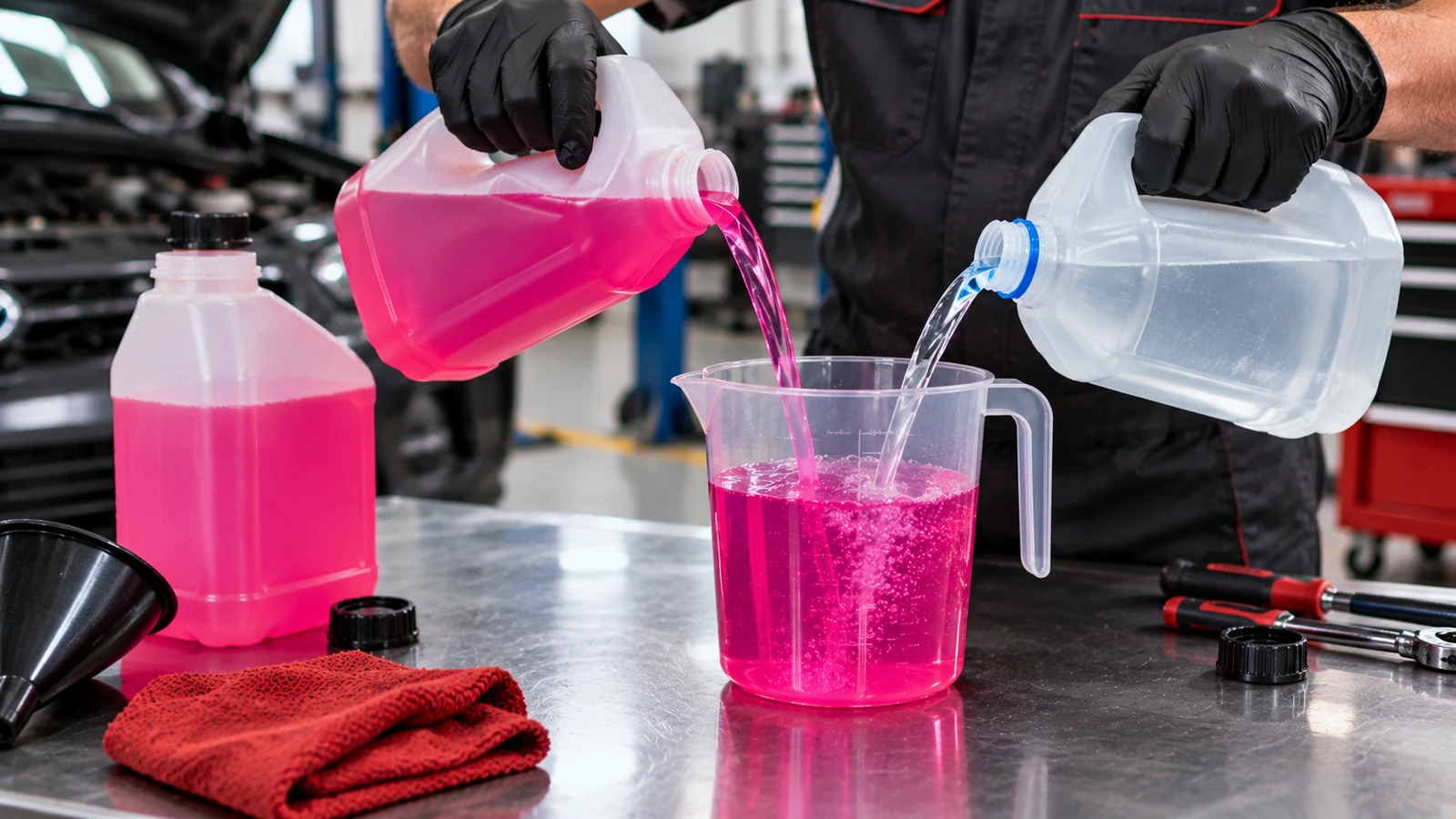
Automotive coolant is commonly sold in two forms.
50/50 Pre-Mixed Coolant
Pre-mixed coolant already contains approximately equal amounts of coolant concentrate and treated water.
It is ready to pour without additional dilution.
A typical 50/50 mixture provides freeze protection to approximately -34°F (-37°C) while also providing the water content needed for effective heat transfer.
Pre-mixed coolant is convenient for routine top-offs because it requires no measuring or mixing.
Full-Strength Concentrate
Dilute concentrated antifreeze before adding it to the cooling system.
A common mixture is:
50% antifreeze concentrate + 50% distilled water
Check the vehicle and coolant manufacturer’s instructions before mixing because required concentrations can vary with operating conditions.
Do not assume that pouring undiluted concentrate into the cooling system provides better protection. Coolant needs the correct water-to-antifreeze ratio to transfer heat and perform properly.
Why Distilled Water Matters
If you are mixing concentrated antifreeze, use distilled or appropriately deionized water rather than ordinary tap water.
Tap water can contain calcium, magnesium, iron, and other minerals.
As the cooling system repeatedly heats and cools, these minerals can build up as deposits inside radiator tubes and cooling passages. Scale can reduce heat transfer and restrict coolant circulation.
Pre-diluted coolant avoids this issue because the manufacturer has already mixed the coolant with suitable water.
Manufacturer Coolant Requirements Are Not All the Same
Vehicle manufacturers specify different coolant formulations because cooling-system designs, engine metals, operating temperatures, water pump seals, and other components vary.
The examples below show why you should check the exact vehicle rather than buying coolant based only on make.
| Manufacturer | Typical Coolant Consideration |
|---|---|
| Ford | Coolant requirements can change significantly by model year and engine. OAT and other long-life Ford specifications are used across newer applications. |
| Chevrolet | Many General Motors applications use Dex-Cool OAT coolant. |
| Toyota | Toyota applications commonly use pink Super Long Life Coolant based on phosphated organic-acid technology. |
| Honda | Honda Type 2 coolant is commonly associated with a blue P-HOAT formulation. |
| Volkswagen | Volkswagen vehicles may specify G12, G13, G12 EVO, or related coolant standards depending on year and platform. |
| Jeep | Jeep applications may require HOAT or OAT depending on model year and powertrain. |
| Nissan | Nissan Long Life Blue coolant is associated with P-HOAT technology in many applications. |
| Porsche | Porsche applications can use phosphate-free OAT or Si-OAT formulations depending on the vehicle. |
These are general examples, not substitutes for vehicle-specific documentation.
Always verify the model, year, engine, and required specification before purchasing coolant.
Where to Find Your Car’s Exact Coolant Specification
Check several places before adding antifreeze.
1. Owner’s Manual
Start with the fluids and maintenance section.
Look for:
- Coolant specification
- Approved coolant type
- Cooling-system capacity
- Mixing ratio
- Replacement interval
2. Coolant Reservoir or Expansion Tank
Some vehicles identify the approved coolant type or specification on the reservoir, cap, or nearby engine-bay label.
Treat this information as more useful than simply looking at the fluid’s color.
3. Factory Workshop or Repair Manual
A factory repair manual can provide much more than the basic coolant type.
Depending on the vehicle documentation, you may find information covering:
- Cooling-system capacity
- Drain locations
- Filling procedures
- Thermostat specifications
- Bleed points
- Cooling-system diagrams
- Water pump procedures
- Radiator servicing
- Torque specifications
For vehicle-specific work, this information is more useful than relying on a generic make-and-model chart.
For example, AutoServicePlus lists factory workshop documentation for the 2015 Toyota Camry XV50 and the 2016-2018 Honda Civic FC/FK.
Owners working on Nissan cooling systems can similarly reference the 2002-2012 Nissan-Datsun Altima Factory Workshop & Repair Manual when that coverage matches their vehicle.
Top-Off vs. Coolant Flush
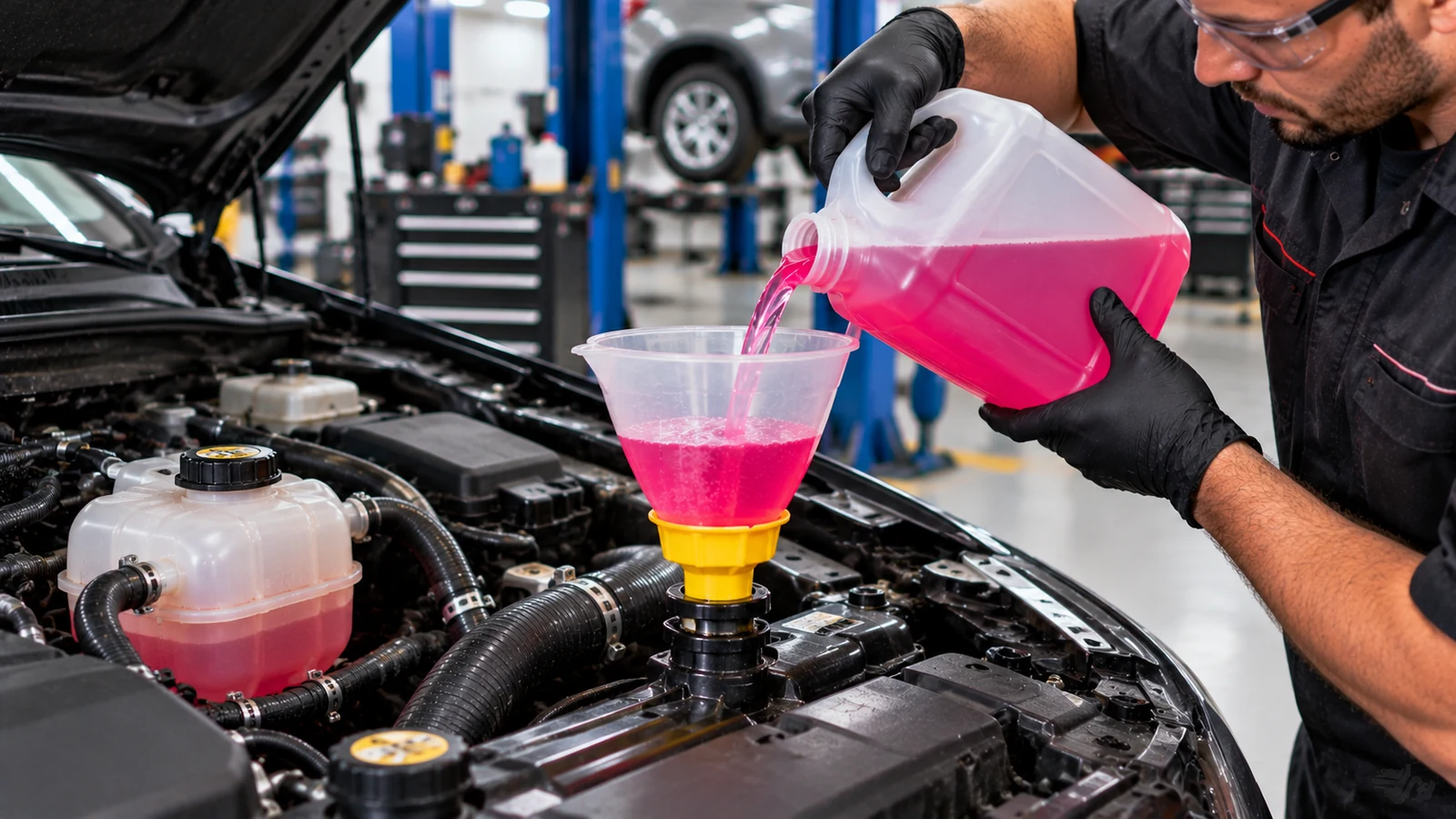
Choosing the right coolant is only one part of the job. You also need to decide whether the system simply needs a top-off or requires more extensive service.
A Top-Off May Be Appropriate When:
- The coolant level is only slightly low.
- The existing coolant type is known.
- The replacement coolant meets the same specification.
- There is no obvious contamination.
- There are no overheating symptoms.
Investigate unexplained coolant loss. Coolant does not normally disappear without a reason.
A Complete Drain or Flush May Be More Appropriate When:
- The existing coolant type is unknown.
- Different coolants have already been mixed.
- The coolant is contaminated.
- You’ve reached the recommended service interval.
- Cooling-system repairs have been performed.
- Deposits or degraded coolant are present.
A full cooling-system service also creates another challenge: removing trapped air after refilling.
Why Cooling-System Bleeding Is Important
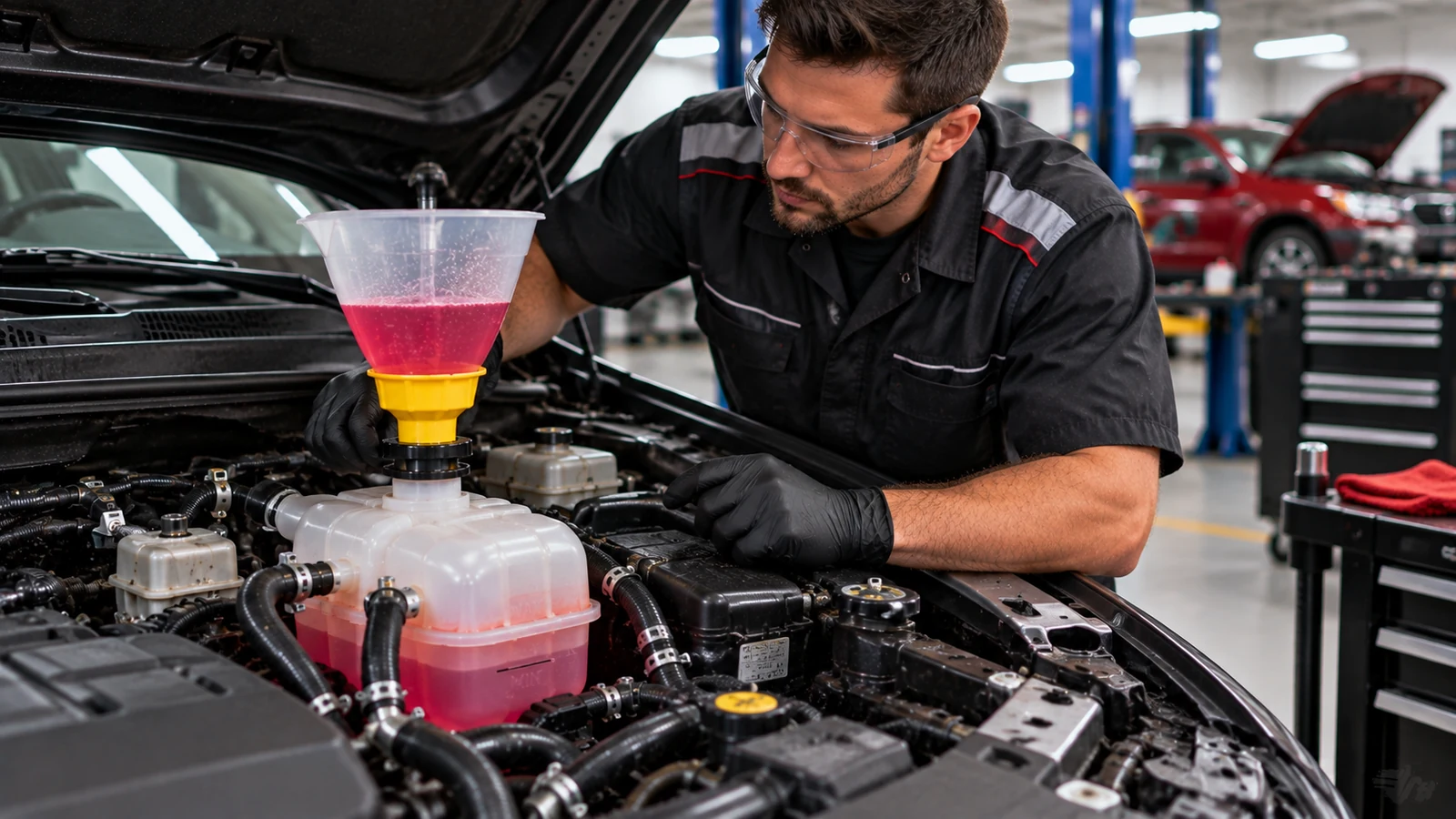
Air pockets can remain in the engine, heater core, hoses, or thermostat housing after draining the coolant.
If trapped air prevents proper circulation, the engine may run hot even though the reservoir appears full.
Some vehicles use dedicated bleed screws. Others require a specific fill sequence, elevated reservoir, vacuum-fill equipment, or electronic bleeding procedure.
This is one reason vehicle-specific repair information is valuable.
For example, owners working on a matching Volkswagen application can consult the 2001-2002 Volkswagen Passat GLS Sedan factory repair manual rather than assuming the refill procedure matches another model.
For more complex European applications, factory documentation such as the 2011-2013 Porsche Cayenne 92A Workshop & Repair Manual provides a vehicle-specific starting point for service information.
DIY Coolant Service vs. Professional Service
A simple top-off and a complete cooling-system service are very different jobs.
| Service | Typical Fluid Cost | Common Equipment | Difficulty |
|---|---|---|---|
| DIY top-off/refill | $15-$30 per gallon | Funnel, gloves, eye protection | Low if the correct coolant is known |
| DIY drain/flush | $30-$60 for fluid and supplies | Drain pan, spill-free funnel, distilled water, coolant tester | Moderate |
| Professional cooling-system service | About $150-$250 | Professional filling/flush equipment | Performed by a service shop |
Costs vary by vehicle, location, coolant capacity, and the amount of service required.
A DIY flush also requires safe coolant collection and disposal. Never dump antifreeze on the ground or into a household drain.
Common Antifreeze Mistakes to Avoid
Buying Coolant Because the Color Matches
A matching color doesn’t prove the chemistry or OEM specification is compatible.
Check the actual specification instead.
Adding Tap Water to Concentrate
Minerals in tap water can contribute to scale and deposits.
Use distilled water when you need to dilute.
Pouring Concentrate in Without Diluting It
More antifreeze is not automatically better.
If the product is full-strength concentrate, prepare the correct mixture before filling unless the vehicle manufacturer specifies otherwise.
Assuming “Universal” Means Identical to OEM Coolant
Universal coolant may claim broad compatibility, but the safest long-term choice is still a product that meets your vehicle’s engineering specification.
Mixing Coolants Without Identifying What Is Already in the System
If you cannot identify the existing coolant, adding another formula can create unnecessary risk.
Consider draining and refilling with the correct coolant instead.
Ignoring Coolant Loss
A low reservoir may indicate a leak from a hose, radiator, water pump, expansion tank, gasket, heater core, or another part of the system.
Repeatedly topping off the reservoir does not fix the cause.
How a Factory Repair Manual Helps With Coolant Service
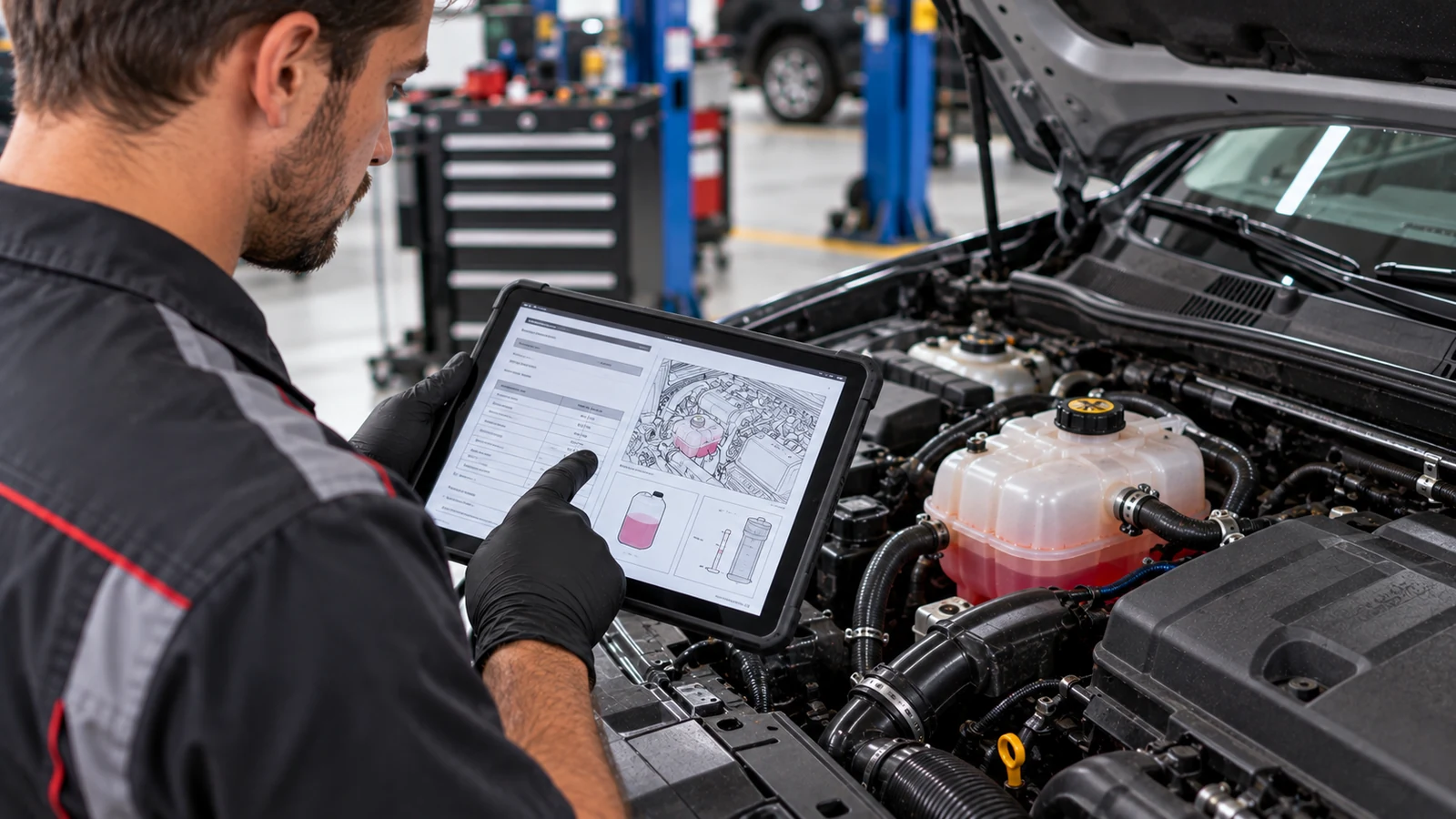
Generic fluid charts are useful for basic research, but factory workshop information is more helpful once the job becomes vehicle-specific.
A manual matched to the correct model and year may help identify the correct service procedure, cooling-system layout, component locations, fluid capacity, and bleeding sequence.
This becomes especially valuable on trucks and vehicles with multiple engines or cooling-system configurations.
For example, AutoServicePlus lists a 2000-2013 Ford F-350 4WD Super Duty Factory Workshop & Repair Manual for owners working on models covered by that documentation.
When choosing a manual, match the year, model, drivetrain, engine, and platform as closely as possible rather than assuming every vehicle sold under the same badge uses identical procedures.
Conclusion
If you are asking, “What antifreeze do I need for my car?”, start with the manufacturer’s specification, not the coolant’s color.
Confirm the required chemistry, check whether you are buying concentrate or a 50/50 pre-mix, use distilled water when dilution is required, and avoid mixing fluids when compatibility is uncertain.
For a routine top-off, that may be all you need.
For a complete drain, flush, repair, or bleeding procedure, vehicle-specific factory service information can help you follow the correct process and avoid preventable cooling-system problems.
Commonly Asked Questions About Choosing the Right Antifreeze for Your Car
Can I Mix Different Colors of Antifreeze?
Do not use color alone to determine compatibility.
Different-colored coolants may sometimes use related technology, while two coolants with similar colors can have different additive packages.
Check the specification and chemistry before mixing.
Can I Mix OAT and HOAT Coolant?
Use the chemistry and specification required by the vehicle manufacturer rather than intentionally mixing unrelated formulations.
OAT and HOAT use different inhibitor packages, and mixing incompatible fluids can reduce the protection the cooling system was designed to receive.
Can I Use Universal Coolant in Any Car?
A universal product may advertise broad compatibility, but that does not make the OEM requirement irrelevant.
Check whether the coolant explicitly meets the specification listed for your vehicle.
If it does not, use an approved alternative.
Is 50/50 Coolant Ready to Use?
Yes. A product labeled as 50/50 or pre-diluted is normally ready to pour without adding water.
Always check the bottle before use.
Do I Add Water to Concentrated Antifreeze?
Normally, yes.
A typical mixture is 50% concentrate and 50% distilled water, but follow the instructions for your vehicle and coolant product.
Can I Use Tap Water With Antifreeze?
Distilled or properly deionized water is preferred because tap water can contain minerals that form deposits inside the cooling system.
What If I Do Not Know What Coolant Is Already in My Car?
First check the owner’s manual, service history, reservoir labeling, and factory specifications.
Don’t assume you can reliably identify the existing fluid by color.
If you can’t identify the coolant and need to add a significant amount, draining and refilling the system with the correct specification may be safer than mixing unknown products.
How Do I Find the Exact Antifreeze Specification for My Car?
Check your owner’s manual or a factory workshop manual for the correct model, model year, and engine.
Look for the manufacturer’s coolant specification rather than relying only on generic terms such as “green coolant,” “European coolant,” or “Asian coolant.”