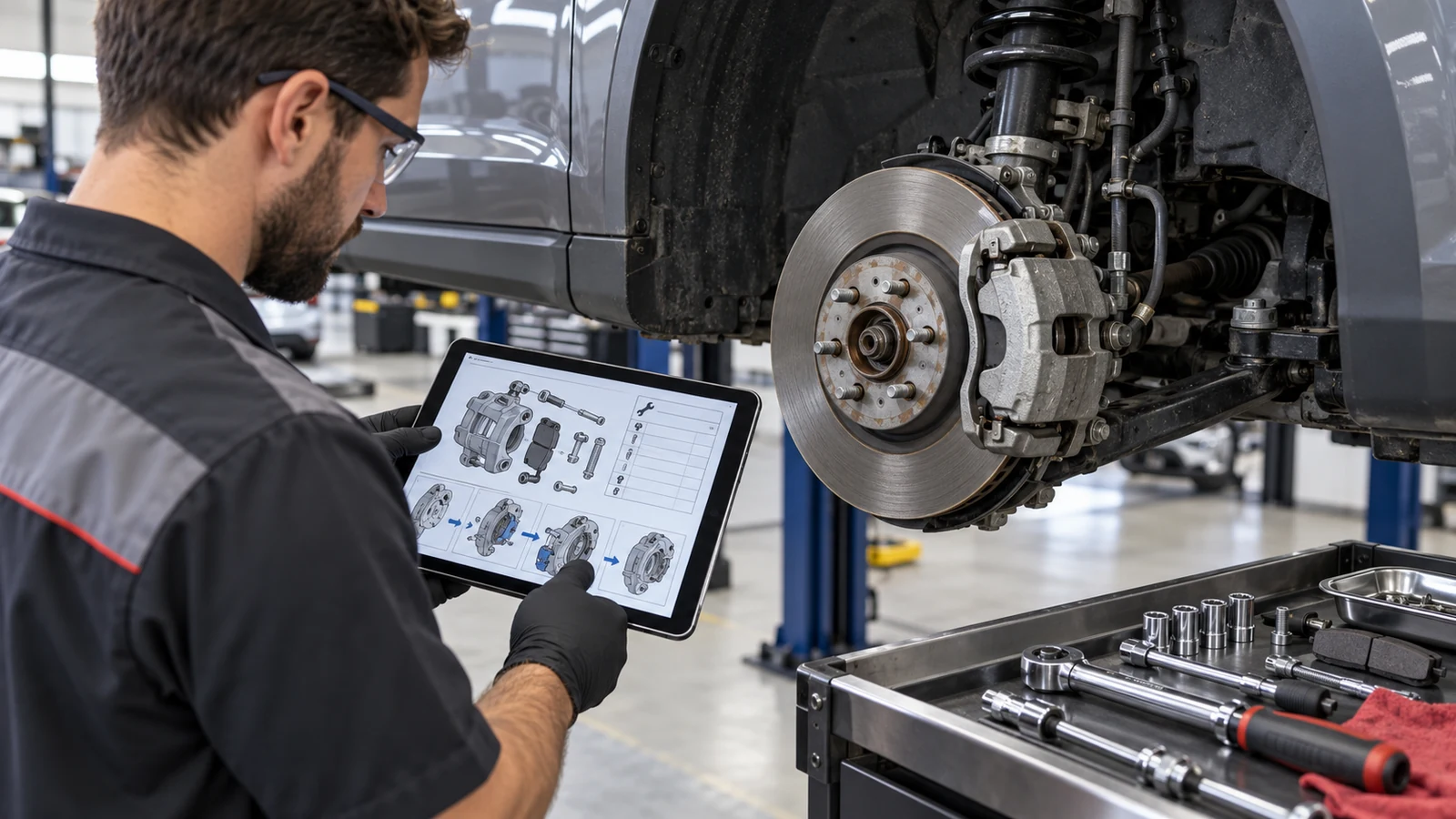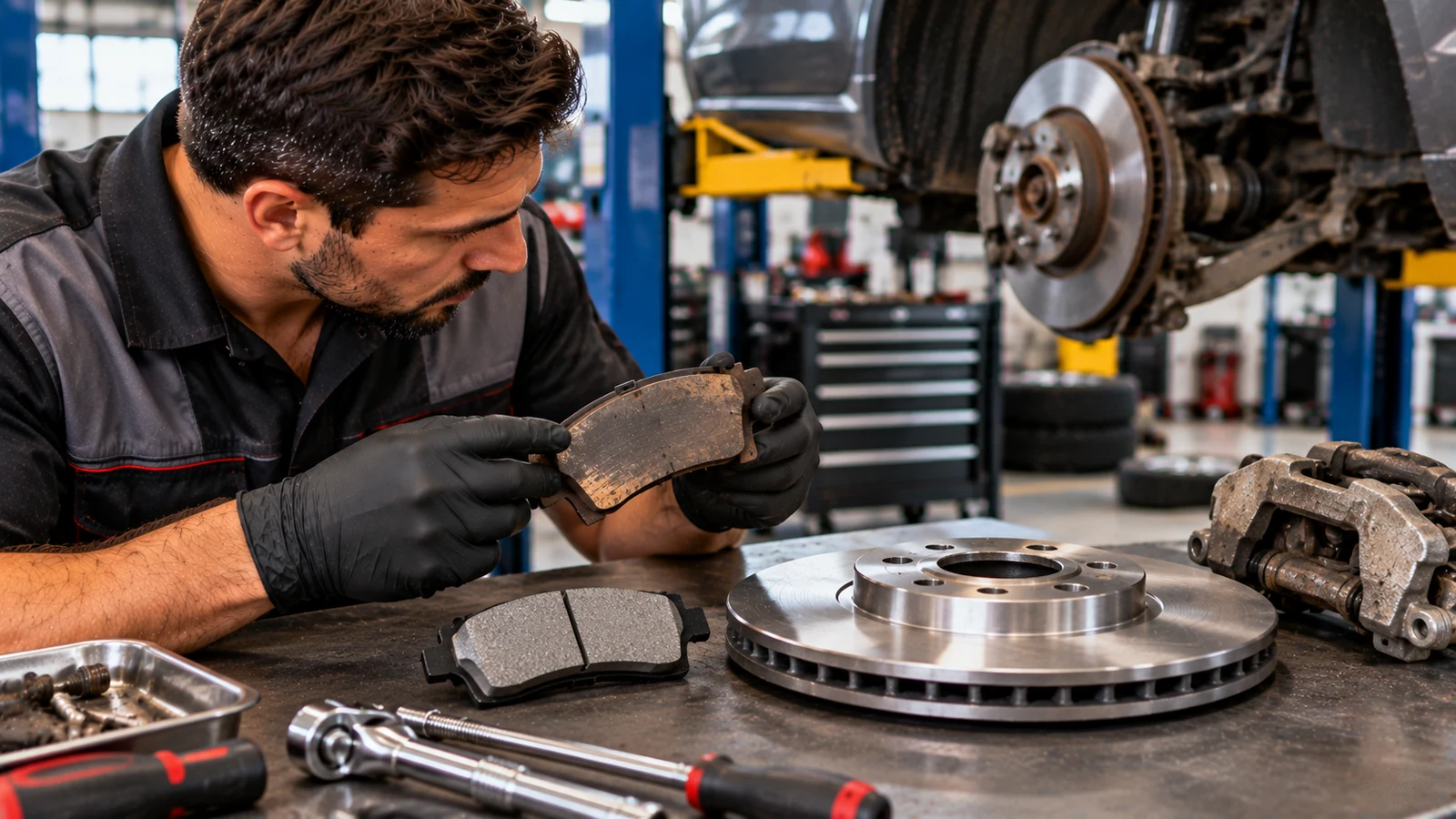
Brake pad replacement is one of the most common brake-service expenses, but the final bill can vary widely. For a typical passenger car, a replacement pad set usually costs about $35 to $75 per axle, while performance, truck, or premium applications can cost $80 to $150 or more per axle. When a repair shop supplies the parts and performs the work, the total is commonly around $150 to $300 per axle.
The important question isn’t just how much brake pads cost. You also need to know whether the rotors can be reused, whether the vehicle uses electronic wear sensors or an electronic parking brake, and whether the job requires model-specific procedures. Delaying service until the friction material is gone can let the steel backing plate contact the rotor, turning a pad-only job into a more expensive rotor or caliper repair.
Brake Pad Cost at a Glance
These ranges help you budget before you inspect the vehicle. Actual prices still depend on the car, axle, brake package, pad compound, and labor rate.
| Brake service item | Typical cost |
|---|---|
| Standard brake pad set, one axle | 20–75 |
| Performance or heavy-duty pad set, one axle | 80–150+ |
| Front pad set | 45–85 |
| Rear pad set | 35–65 |
| Independent shop, pads installed, one axle | 150–250 |
| Dealership, pads installed, one axle | 230–370 |
| DIY pad parts, one axle | 35–65 |
| Independent shop, pads and rotors, one axle | 250–450 |
| Dealership, pads and rotors, one axle | 350–600+ |
| DIY pads and rotors, one axle | 100–180 |
For both front and rear axles, a practical budget is around $300 to $500 at an independent shop, $460 to $740 at a dealership, or $70 to $130 for DIY pad parts.
What Determines How Much Brake Pads Cost?
Brake pads look simple, but several practical factors drive price differences. The friction compound matters, but so do vehicle weight, axle load, pad size, sensor requirements, included hardware, and whether the parts are OEM or aftermarket.
Friction Material Changes Price, Wear, Noise, and Dust
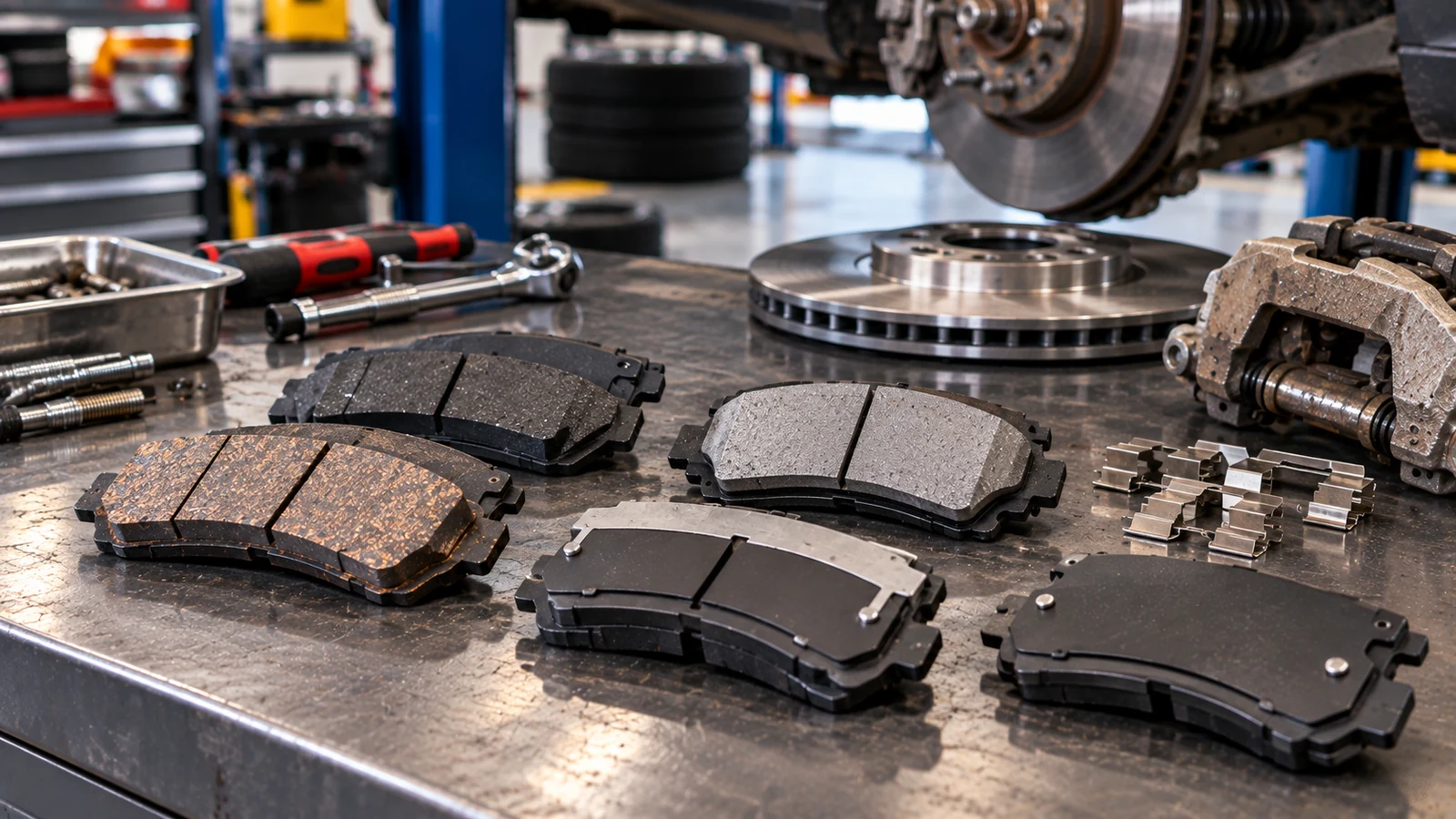
| Pad material | Typical price per axle | Typical life range | General characteristics |
|---|---|---|---|
| Organic / NAO | 20–40 | 25,000–40,000 miles | Softer feel, generally quiet, faster wear, more dust |
| Semi-metallic | 30–60 | 35,000–50,000 miles | Strong bite and heat resistance, more noise and dust |
| Ceramic | 40–100 | 50,000–75,000+ miles | Quiet operation, low dust, smooth feel, longer life |
| Carbon-ceramic / heavy-duty | 80–200+ | 60,000–90,000 miles | High heat capacity, specialized use, highest cost |
A cheaper pad set can still stop the vehicle, but the total value depends on what is included. Premium sets may add multi-layer noise shims, chamfered or slotted pad edges, stainless pad clips, and suitable lubricant. Budget sets may require you to reuse hardware or purchase it separately.
Front and Rear Axles Do Not Always Cost the Same
Front brakes usually handle a larger share of the braking load, so front pads are often larger and slightly more expensive. Front brakes commonly handle the greater share of braking load, with about 70% often used as a typical estimate during deceleration. Front pad sets are therefore commonly budgeted at $45 to $85, compared with $35 to $65 for rear sets.
Rear brake service can become more expensive when the vehicle uses an electronic parking brake, integrated parking-brake hardware, or electronic wear sensing. Premium European applications may require replacement wear sensors that add roughly $15 to $35 per axle.
Vehicle Size and Parts Tier Matter
Compact passenger vehicles can use pad sets in roughly the $25 to $50 range, while heavy SUVs, full-size pickups, and commercial vans may need $60 to $120 heavy-duty sets. Genuine OEM pads can cost around $80 to $150 per axle, while quality aftermarket sets may fall closer to $40 to $75.
This is why two vehicles receiving the same basic service can produce very different invoices. The brake package fitted to the exact model matters more than the general idea of “front pads” or “rear pads.”
When the Job Becomes More Than a Pad Replacement
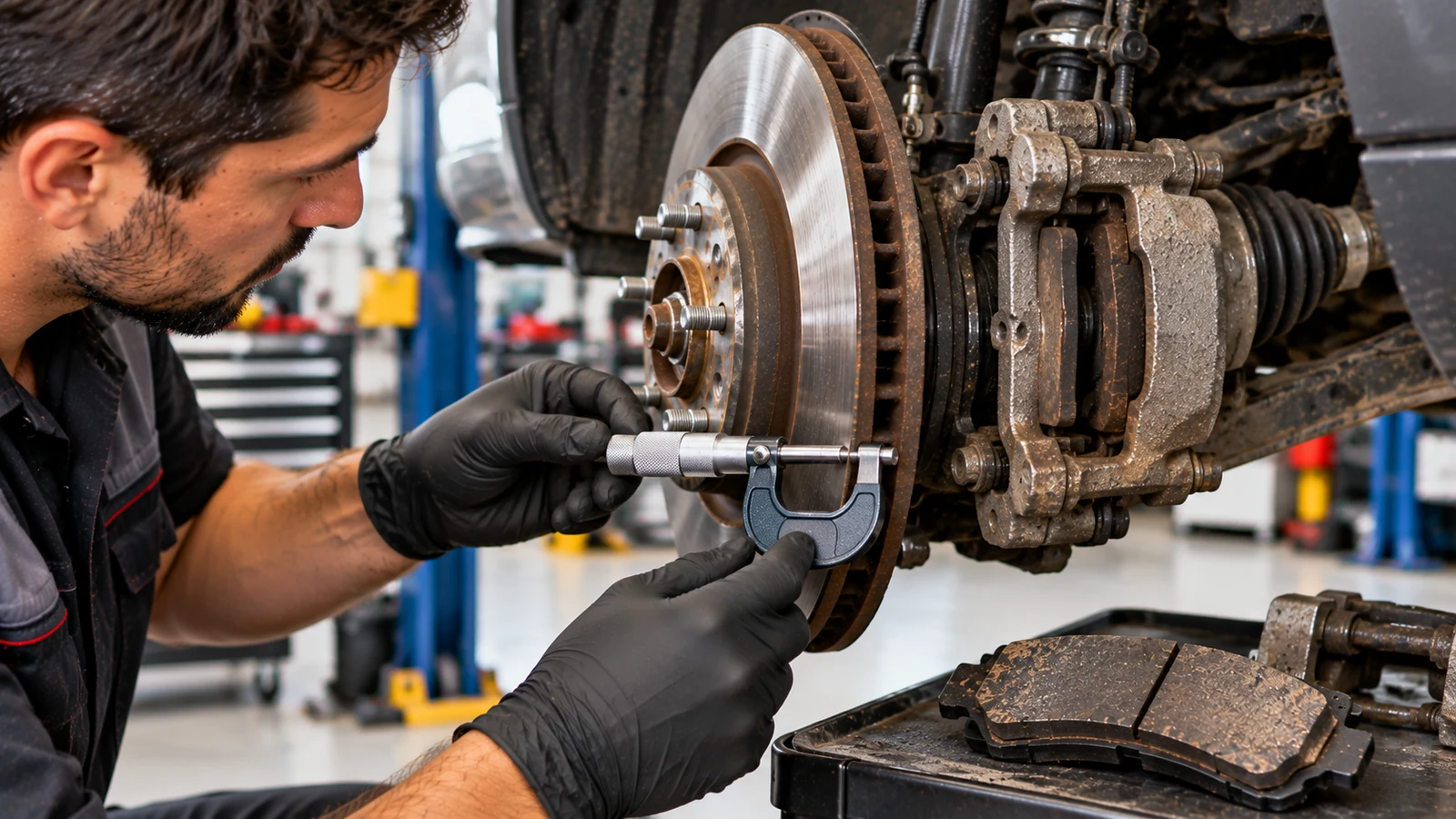
The cheapest brake job is usually the one done before the pads wear through completely. Once the friction lining is gone, the steel backing plate can grind into the rotor, creating deep grooves and excessive heat. That can require rotor replacement and, in severe cases, contribute to caliper damage.
Brake vibration also changes the diagnosis. A pulsing pedal or steering-wheel shake under braking can point to rotor thickness variation, uneven rotor wear, or hub runout rather than simple worn pads. In that situation, replacing pads alone may not correct the problem.
Before ordering parts, inspect:
- Remaining pad thickness on the inner and outer pads.
- The rotor surface for scoring, cracking, or heavy heat damage.
- Rotor thickness against the vehicle’s minimum specification.
- Caliper slide movement and dust-boot condition.
- Wear sensor condition where fitted.
- Brake-fluid leaks or damaged hoses.
- Parking-brake operation on the rear axle.
If the rotor is below its service limit or badly damaged, base the cost comparison on a pads-and-rotors job rather than pads alone.
Shop vs DIY Brake Pad Replacement
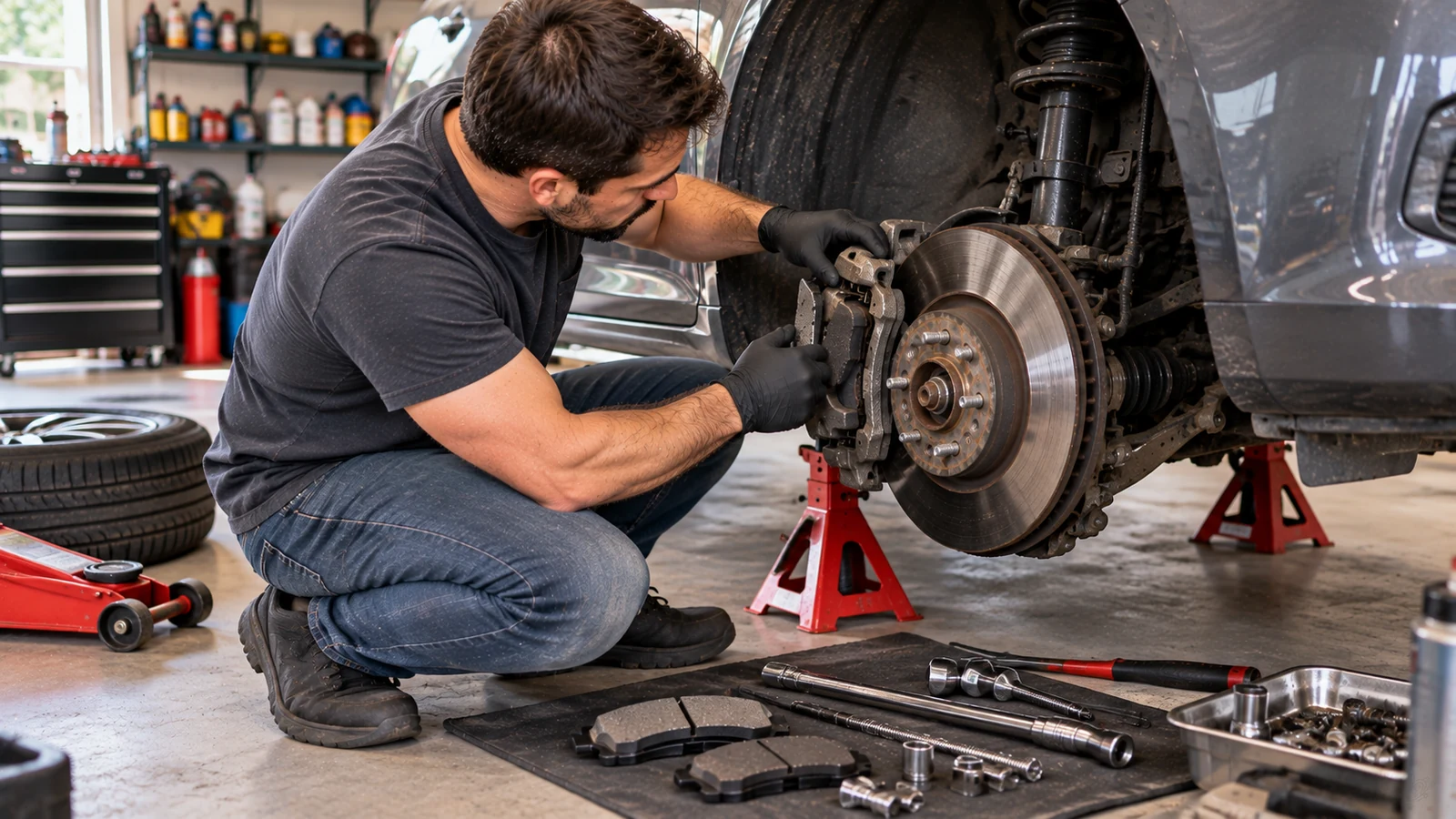
Professional brake service includes more than the pad set. A typical labor budget is around $90 to $150 per hour at an independent shop and $140 to $ 220+ per hour at a dealership. With roughly one hour of labor commonly budgeted for a one-axle pad service in this cost model, labor quickly becomes the largest difference between DIY and professional service.
| Option | Typical one-axle total | Main advantage | Main consideration |
|---|---|---|---|
| DIY | 50–65 for pads | Lowest cash cost | Requires tools, safe lifting, correct procedure |
| Independent shop | 150–250 | Lower labor cost than dealer | Parts may include markup |
| Dealership | 230–370 | OEM parts and dealer workflow | Highest typical cost |
A home mechanic can save roughly $100 to $200 per axle on labor, but only if the work is done correctly. The vehicle must be lifted at the proper points, the caliper must be supported without straining the hose, the piston must be retracted correctly, and all fasteners must be tightened to the proper specification.
For an older sedan example, the Ford repair manual library includes model-specific service information, and the 2005–2007 Ford Five Hundred 2WD workshop manual is a direct reference for that application. In this price guide, aftermarket ceramic pads for Ford run about $35 to $65 per axle, while genuine Ford pads run about $70 to $110.
Family-vehicle brake work also benefits from exact model data. You can narrow theHonda workshop manual collection to a specific vehicle, such as the 1997–2002 Honda Odyssey LX repair manual. In this price guide, aftermarket pads run around $35 to $60 per axle, while genuine Honda pads run around $65 to $95.
Why Vehicle-Specific Workshop Information Matters
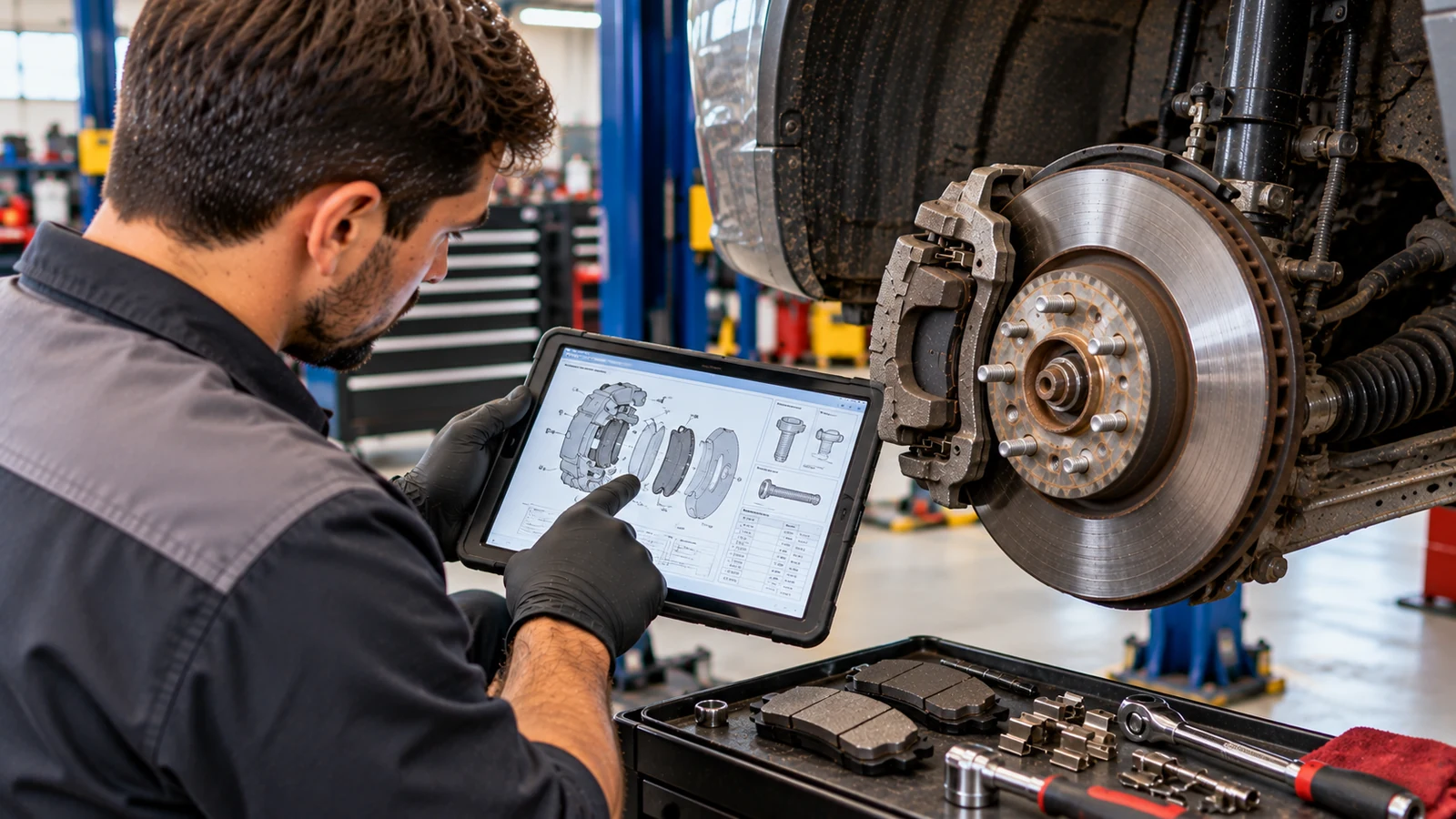
Brake pads are not installed by price range. They are installed on a specific brake system, and that system determines the torque values, hardware layout, sensor arrangement, piston-retraction method, and inspection limits.
A factory-style workshop manual can help confirm:
- Caliper and bracket fastener torque. Generic torque values are not a substitute for the exact specification.
- Pad, shim, spring, and anti-rattle clip orientation. Incorrect hardware placement can cause noise or uneven wear.
- Rear piston or electronic parking-brake procedure. Some systems require a defined service mode before rear caliper work.
- Wear sensor installation. Vehicles with electronic sensors may require a new sensor or a specific routing path.
- Safe lifting points. Correct jacking and support locations reduce the risk of body damage or an unstable vehicle.
- Hydraulic procedures. If you open a brake hose or hydraulic connection, the correct bleeding process becomes part of the repair.
Volkswagen owners can start with the Volkswagen service manual library and then match the exact year and model, such as the 1990–1993 Volkswagen Jetta workshop manual. Volkswagen pad costs in this guide fall around $40 to $80 per axle. On later vehicles with an electronic parking brake, rear-brake service may also require the correct procedure before retracting the caliper piston.
Electronic wear monitoring can also change both parts cost and service steps. The BMW repair manual collection includes the 1999–2000 BMW 528i E39 workshop manual. BMW pad sets in this guide fall around $50 to $110 per axle, with single-use electronic wear sensors adding about $20 to $35 each on applicable systems.
For Audi, the Audi factory repair manual section includes the 1988–1991 Audi 90 workshop manual. Replacement pads in this guide run about $55 to $120 per axle. Pad-thickness checks and wear-sensor handling are also important where fitted.
Performance brakes can make correct procedures even more important. The Chevrolet workshop manual library includes the 2014–2017 Chevrolet Corvette C7 repair manual. Standard Chevrolet pad sets in this guide run around $30 to $60 per axle, while Corvette performance sets can reach about $90 to $180 per axle.
At the higher end, the Porsche service manual collection includes the 1983 Porsche 911 SC Cabriolet workshop manual. Porsche high-friction pad sets in this guide run around $90 to $220 or more per axle, with dealership brake-pad service potentially exceeding $500 per axle.
Vehicle-Specific Brake Service Examples on AutoServicePlus
The AutoServicePlus inventory covers a wide range of brands and vehicle-specific workshop manuals. The examples below avoid unsupported brand-specific price claims and instead show where factory-style service information can help confirm procedures, hardware arrangement, torque specifications, and service limits for the model being repaired.
Passenger Cars and Family Vehicles
This guide budgets Toyota replacement pads at $40 to $75 per axle. Owners can browse Toyota workshop manuals and use a model-specific reference such as the 1986–1987 Toyota Cressida Sedan workshop manual before disassembling the caliper hardware.
This guide budgets Hyundai replacement pads at $30 to $55 per axle. The Hyundai service manual library includes the 1996–2001 Hyundai Tiburon RC-series repair manual, which gives a model-specific place to verify service details rather than relying on generic instructions.
For Nissan, this guide budgets aftermarket ceramic pads at about $30 to $60 per axle. The Nissan workshop manual section includes the 1993–1998 Nissan-Datsun Quest Minivan repair manual.
The supplied AutoServicePlus inventory also contains brands for which this guide does not assign a separate brake-pad price range. For those vehicles, the manual links are still useful for procedure verification. Examples include the Mazda repair manual library with the 2013–2014 Mazda CX-5 AWD workshop manual, and the Cadillac service manual collection with the 2013–2015 Cadillac ATS repair manual.
For Mercedes-Benz applications in the supplied inventory, you can pair theMercedes-Benz workshop manual section with an exact model reference, such as the 2006 Mercedes-Benz C 280 workshop manual. Use the vehicle-specific manual to verify the actual brake package and procedure, rather than assuming one Mercedes brake setup applies across the range.
SUVs, 4x4s, Crossovers, and Pickups
Jeep heavy-duty pad sets in this guide are budgeted around $40 to $85 per axle, with 4x4 use adding potential contamination and thermal demands. The Jeep workshop manual library includes the 1996–2002 Jeep Wrangler repair manual for model-specific service reference.
Subaru ceramic pad sets in this guide are budgeted around $35 to $70 per axle. The Subaru service manual collection includes the 1986–1987 Subaru L-Series 4WD workshop manual, which can help the technician confirm the exact layout on an older 4WD application.
Pickup-truck brake parts often cost more because the vehicle requires larger, higher-capacity components. AutoServicePlus includes a Ram workshop manual section and a 2021 Dodge Ram 1500 workshop manual for model-specific procedures.
Crossovers and SUVs can also vary widely by drivetrain and brake package. The supplied inventory includes the Volvo repair manual library with the 2004–2013 Volvo XC90 AWD workshop manual, the Land Rover service manual collection with the 2015–2017 Discovery Sport L550 workshop manual, and the Lexus workshop manual library with the 2010–2013 Lexus RX 450h AWD repair manual.
Performance-Oriented and Larger Brake Packages
Performance-oriented cars may use larger pads, multi-piston calipers, or higher-friction compounds, which can drive brake-pad pricing up quickly. The supplied AutoServicePlus URLs include the Dodge service manual library and the 2014 Dodge Charger LD workshop manual. For any performance or heavy-duty application, confirm the exact brake package before ordering pads because trim-level differences can change pad shape and hardware.
Practical Checklist Before Ordering Brake Pads
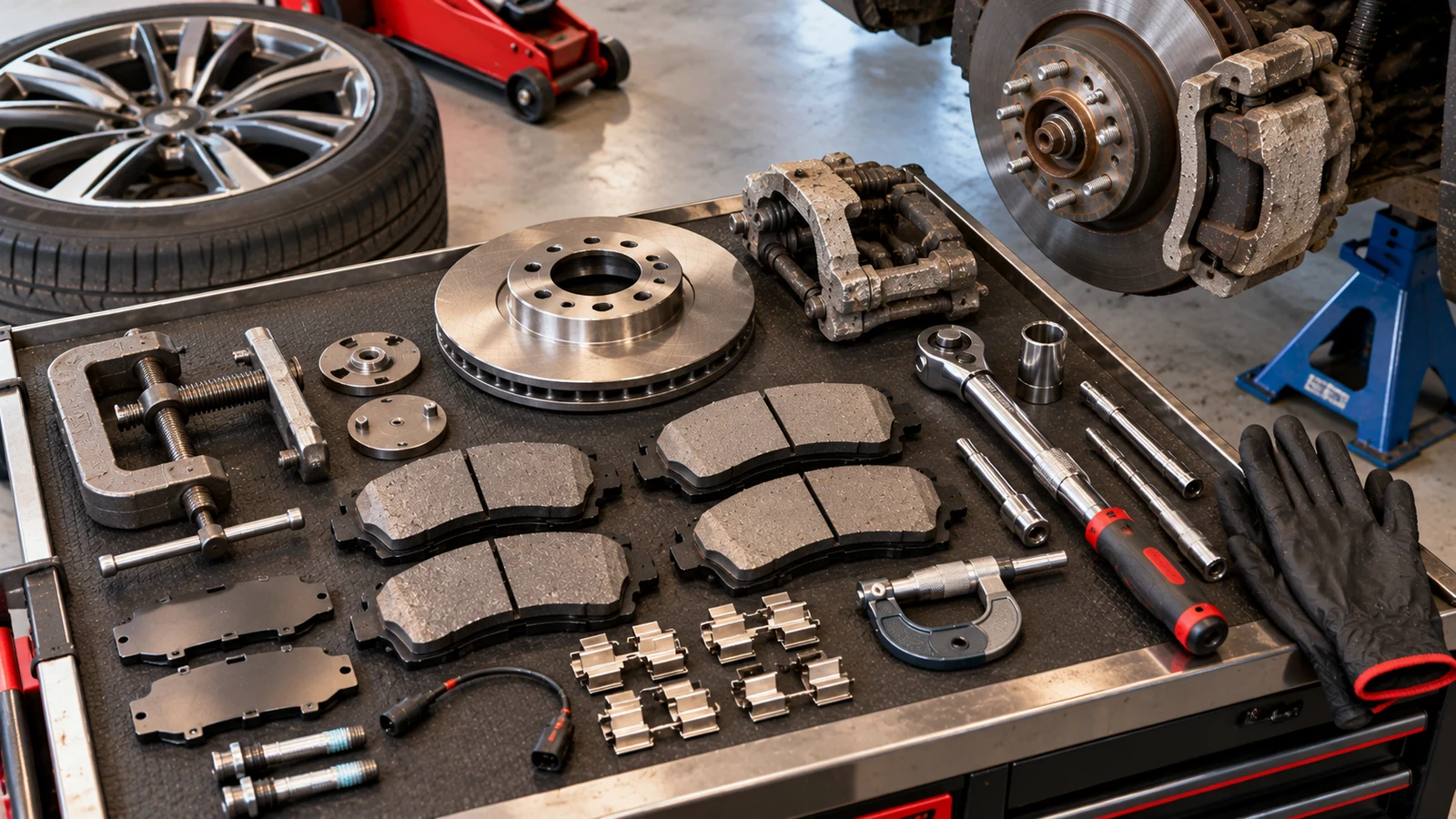
A low online price is useless if the pads don’t match the caliper or if the job needs extra parts. Before ordering, follow these steps.
- Confirm the exact vehicle. Match year, model, engine, drivetrain, and brake package where applicable.
- Identify the axle. Front and rear pad sets are different and may use different sensors or hardware.
- Measure remaining lining. A practical replacement point used in this guide is about 3 mm of remaining friction material.
- Inspect both inner and outer pads. Uneven wear can indicate a slide-pin, piston, or hardware issue.
- Measure the rotor. Compare actual rotor thickness with the vehicle’s minimum specification before deciding to reuse it.
- Check for electronic wear sensors. Add sensor cost if the design requires replacement.
- Check rear-brake service requirements. Confirm whether you must rotate, compress, or electronically retract a rear piston.
- Inspect included hardware. Determine whether the pad set includes new shims, clips, and lubricant.
- Plan the lifting method. Use the correct jacking and support points and never rely on a jack alone.
- Verify torque values before assembly. Tighten the caliper, bracket, and wheel fasteners to the vehicle’s specified values.
Common Brake Pad Cost Mistakes
The most common budgeting errors happen when the owner prices only the pad box and ignores the condition of the rest of the brake system.
- Assuming pads are the only worn parts. A damaged rotor can add hundreds of dollars per axle.
- Comparing front and rear prices as if they are identical. Front sets are commonly larger and more expensive.
- Ignoring sensors and hardware. Electronic wear sensors, clips, or shims can change the parts total.
- Choosing pads only by lowest price. Noise-control hardware and friction material affect long-term value.
- Ordering before checking the exact brake package. The same model may use different pad shapes across trims or production ranges.
- Treating DIY labor as completely free. You may still need a jack, stands, a torque wrench, a piston tool, a scan-tool function, or other service equipment.
- Skipping rotor measurements. Reusing a rotor that is below minimum thickness can compromise the repair.
Conclusion
If you are asking how much brake pads are, a realistic starting budget is $35 to $75 per axle for standard parts or roughly $150 to $300 per axle for typical professional replacement. The job becomes more expensive when the vehicle uses premium friction materials, large performance brakes, electronic sensors, specialized rear-caliper procedures, or rotors that can no longer be reused.
The best way to control the final cost is to inspect the complete brake assembly before buying parts. Confirm pad thickness, rotor condition, sensor requirements, and the exact procedure for your vehicle. That lets you compare a true pad-only repair with a pads-and-rotors job and decide whether DIY or professional service makes more sense.
Frequently Asked Questions
How Much are Brake Pads for A Normal Car?
For parts alone, a typical passenger-car pad set is about $35 to $75 per axle. Shop-installed replacement commonly runs about $150 to $250 per axle at an independent repair shop, while dealership service can be around $230 to $370 per axle.
How Much Does It Cost to Replace Brake Pads on All Four Wheels?
Independent-shop replacement for both axles is roughly $300 to $500, dealership replacement is about $460 to $740, and DIY pad parts are around $70 to $130.
Are Ceramic Brake Pads Worth the Higher Price?
Ceramic pads typically cost more than semi-metallic pads, around $40 to $100 per axle compared with $30 to $60 for semi-metallic pads. Their advantages include less dust, quieter operation, smoother braking, and a longer expected service life.
How Much Do Brake Pads and Rotors Cost Together?
A pads-and-rotors job typically costs $250 to $450 per axle at an independent shop and $350 to $600 or more per axle at a dealership. DIY parts are estimated around $100 to $180 per axle.
Are Front Brake Pads More Expensive Than Rear Pads?
Usually, yes. Front sets typically cost $45 to $85, and rear sets $35 to $65. Front brakes generally handle more of the stopping load, so the pads are often larger.
How Often Should Brake Pads Be Replaced?
A broad normal replacement range is 30,000 to 70,000 miles, with heavy stop-and-go driving potentially shortening life to around 25,000 miles and highway use sometimes extending it beyond 70,000 miles. Pad thickness and condition are more useful than mileage alone, and about 3 mm of remaining friction material is a practical replacement point.
Can I Replace Brake Pads Myself?
Yes, if you have the tools, safe lifting equipment, and the correct procedure for your vehicle. DIY can save roughly $100 to $200 per axle in labor, but the job still requires correct piston retraction, hardware installation, fastener torque, and post-service checks.
Do I Need A Workshop Manual for A Brake Pad Job?
A vehicle-specific workshop manual is especially useful for torque specifications, jacking points, caliper hardware orientation, electronic parking-brake service procedures, wear-sensor routing, and rotor service limits. Those details can differ between models even when the general pad-replacement process looks similar.