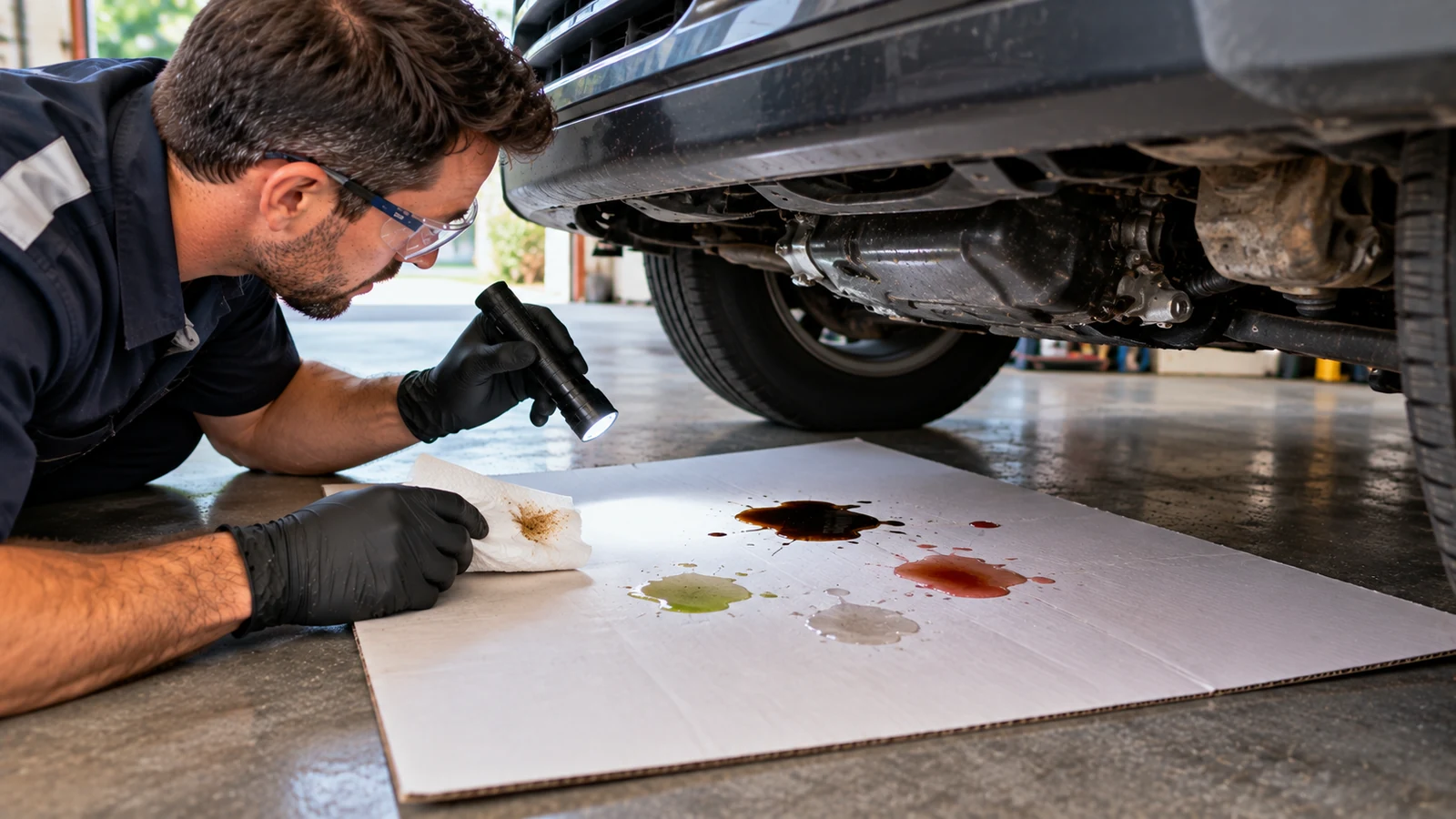
Finding a fresh puddle under your car does not automatically mean an expensive repair. Some drips are normal condensation. Others can point to a coolant leak, a failing oil seal, a transmission problem, a brake-system fault, or a fuel leak that needs immediate attention.
The quickest way to identify a car leak is to combine four clues: color, smell, texture, and where the fluid appears under the vehicle. Color alone is not reliable enough. Used engine oil turns dark, old transmission fluid can become brown, several coolant formulas use different colors, and fresh brake fluid may look almost like water.
A clean sample and a few careful observations can often narrow the problem to one system before you remove any parts.
One safety rule comes first: never taste an unknown automotive fluid, do not inhale fumes directly, and never open a hot pressurized cooling system.
Key Takeaways
- Use color, smell, texture, and location together rather than identifying a leak by color alone.
- Sweet, watery fluid usually suggests coolant, while dark slick fluid usually points toward engine oil.
- Red or pink oily fluid may come from an automatic transmission or hydraulic power-steering system.
- Thick lubricant with a strong sulfur smell is usually gear or differential oil.
- Clear, odorless water beneath a vehicle after using the air conditioner is normally condensation.
- Brake-fluid and active fuel leaks should be treated as stop-driving faults.
- Clean-and-recheck inspection, pressure testing, or suitable UV dye can help confirm the actual leak point.
- Confirm the fluid type, capacity, tightening torque, bleeding method, and fill procedure for the exact vehicle before you repair it.
Start With These Four Clues Before Looking for Parts
A puddle directly below a component provides useful information, but fluids can travel along brackets, covers, hoses, and underbody panels before reaching the ground. Road airflow can also carry a leak rearward.
Use all four clues together.
Color Gives You The First Shortlist
Place a few drops on white paper or cardboard. Dark pavement makes almost every automotive fluid look darker than it really is.
Common patterns include:
- Amber, brown, or black: often engine oil.
- Green, pink, orange, yellow, blue, or purple: potentially coolant.
- Red or pink: often automatic transmission or hydraulic steering fluid.
- Clear to pale amber: potentially brake or clutch fluid.
- Blue or brightly colored and watery: potentially washer fluid.
- Clear and odorless: usually water condensation.
- Pale amber and rapidly evaporating: potentially gasoline.
- Thick amber or brown: potentially gear oil.
Color is only the first clue because fluid appearance changes with age and contamination.
Smell Separates Fluids That Look Similar
Do not place your face directly over a puddle. Put a small amount on a paper towel and gently waft the odor toward you.
Typical odors include:
- Sweet or syrup-like: coolant.
- Petroleum or burnt oil: engine oil.
- Sharp burnt petroleum: overheated transmission fluid.
- Sulfur or rotten eggs: gear oil.
- Strong gasoline odor: gasoline.
- Heavy oily fuel odor: diesel.
- Alcohol or glass-cleaner smell: washer fluid.
- Ammonia-like smell: diesel exhaust fluid.
- No noticeable odor: usually water.
Texture Narrows The Diagnosis Further
With nitrile gloves on, a small sample can help distinguish fluids.
- Water and washer fluid are very thin.
- Coolant is watery with a slightly slippery or slimy feel.
- Brake fluid is thin but slippery.
- Engine oil is noticeably slick.
- Transmission and steering fluids are oily.
- Gear oil is thick and sticky.
Never intentionally touch fuel, battery electrolyte, or unknown chemical residue.
Location Tells You What System Is Above The Puddle
On a typical front-engine vehicle:
- Front center: radiator, cooling-system parts, or front-mounted cooler lines.
- Directly below engine: engine oil, coolant, or another engine-mounted fluid.
- Behind engine or near vehicle center: transmission or the engine-to-transmission joint.
- Inside a wheel: brake fluid, axle-seal lubricant, or CV-joint grease.
- Near firewall: A/C condensation drain, heater hoses, or heater-core related leakage.
- Rear center: differential.
- Along underside or near fuel tank: fuel-system leak.
The first fresh wet point found above the puddle is normally more useful than the spot on the ground.
Quick Car Fluid Leak Identification Chart
| Color or appearance | Typical smell | Texture | Likely source | Typical urgency |
|---|---|---|---|---|
| Amber to black | Petroleum, sometimes burnt | Slick | Engine oil | Check level and repair |
| Green, orange, pink, yellow, blue, purple | Sweet | Watery/slightly slimy | Coolant | Moderate to urgent |
| Red or pink, possibly brown when old | Petroleum, burnt when overheated | Oily | Automatic transmission fluid | Moderate to urgent |
| Red, amber, clear, or sometimes green | Oily | Oily | Hydraulic power-steering fluid | Moderate |
| Clear to amber | Faint chemical | Thin/slippery | Brake or clutch fluid | Stop driving |
| Amber to dark brown | Strong sulfur | Thick/sticky | Gear or differential oil | Repair soon |
| Blue, green, pink, or orange | Alcohol/glass cleaner | Watery | Washer fluid | Low urgency |
| Clear | None | Water | A/C condensation | Normal |
| Clear to pale amber | Strong gasoline | Very thin | Gasoline | Stop driving |
| Clear to pale yellow | Heavy fuel odor | Oily | Diesel | High urgency |
| Clear with white crystals after drying | Faint ammonia | Watery | DEF/AdBlue | Repair soon |
| White or blue-green crust | Possible sulfur smell nearby | Crystalline | Battery corrosion | Inspect promptly |
Brown or Black Leaks: Engine Oil and Lubricating Oil
Fresh engine oil can be amber or honey-colored, but used oil commonly appears dark brown or black. It feels slick, doesn’t evaporate quickly, and leaves an oily, translucent stain.
A burnt-oil smell may appear before you see a puddle. Oil from a valve-cover gasket or another upper-engine seal can land on a hot exhaust component and burn away.
Common engine-oil leak points include:
- Drain plug or sealing washer.
- Oil filter or filter housing.
- Valve-cover gasket.
- Oil-pan gasket.
- Crankshaft seals.
- Oil-pressure sender.
- Oil cooler connections.
- Turbocharger oil lines where fitted.
If the leak appeared immediately after an oil service, inspect the drain plug and filter area first.
A rear main seal leak may appear near the joint between the engine and transmission, so leak location alone cannot always distinguish engine oil from transmission fluid.
For vehicle-specific gasket locations and removal procedures, AutoServicePlus provides Subaru workshop manuals. For a matching vehicle, the 2010–2013 Subaru Outback workshop manual can verify component locations, tightening specifications, seal requirements, and engine-specific repair steps instead of relying on a generic diagram.
Brown does not always mean engine oil
Other fluids can also become brown:
- Old automatic transmission fluid can become reddish-brown.
- Gear oil can be dark brown but is much thicker and has a strong sulfur odor.
- Old brake fluid darkens with age.
- Contaminated coolant can appear rusty brown while remaining watery.
- Grease from a damaged CV boot is thick and may be thrown around the inside of a wheel.
Check the matching reservoir or dipstick before assuming every brown stain is engine oil.
Green, Orange, Pink or Yellow Leaks: Coolant
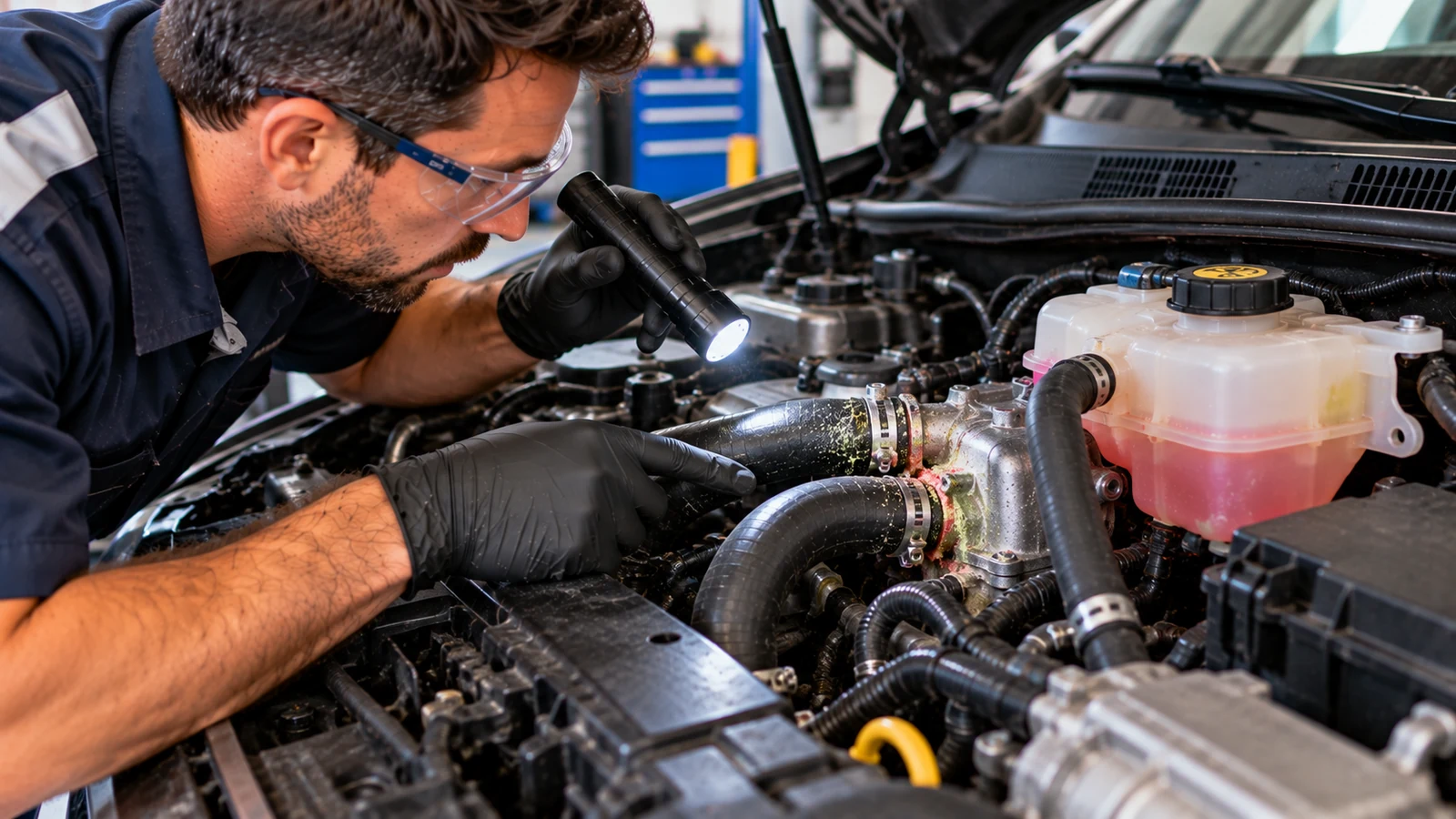
Coolant is deliberately dyed, but manufacturers don’t standardize the color. Green, pink, orange, yellow, blue, and purple coolants all exist.
Do not select replacement coolant by color alone.
Coolant usually has three useful identifying characteristics:
- A sweet smell.
- A watery but slightly slippery feel.
- Colored or crusty residue where an older leak has dried.
Typical cooling-system leak areas include the radiator, hoses, thermostat housing, water pump, reservoir, heater hoses, and heater core.
If the coolant is dripping under the engine, determine what sits directly above the wet point. A water-pump leak, thermostat-housing leak, and hose connection can all leave a puddle in a similar area.
Matching service documentation is useful because coolant capacity, bleed points, component layout, and pressure-test specifications vary. The Chevrolet workshop manual library provides manufacturer-specific coverage, while the 2011–2013 Chevrolet Cruze factory workshop manual gives model-specific repair information for matching Cruze applications.
The same applies to other vehicles. Toyota workshop manuals can be used to identify the correct cooling-system procedure, and owners of a matching application can refer to the 2007–2013 Toyota Camry factory workshop manual for vehicle-specific component and service information.
Coolant inside the cabin needs attention too
A heater-core leak may not leave an obvious puddle under the engine.
Possible signs include:
- Sweet odor through the vents.
- Damp front carpeting.
- Greasy film on the inside of the windshield.
- Repeated coolant loss.
- Poor heater performance.
- Gurgling behind the dashboard.
If coolant is escaping with steam or the engine temperature is rising, shut the vehicle down rather than continuing to drive.
Coolant is also toxic. Clean spills promptly and keep them away from children and animals.
Red or Pink Leaks: Transmission and Steering Fluids
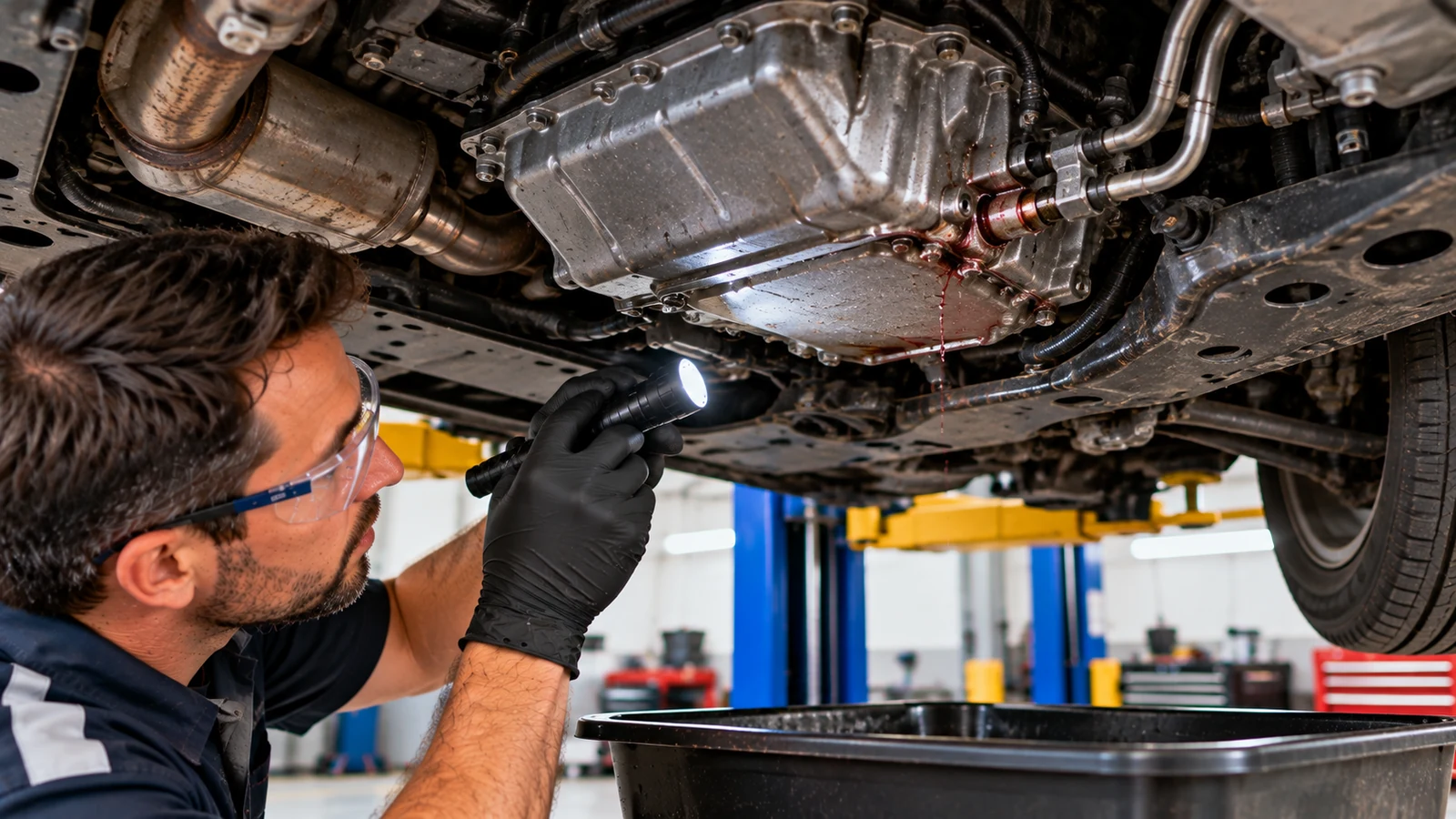
Automatic transmission fluid is commonly red or pink when fresh and may darken toward brown as it ages. Hydraulic power-steering fluid can look similar, and some systems use automatic transmission fluid as the steering fluid.
Location is therefore more useful than color.
A transmission leak may appear around:
- Transmission pan.
- Drain or fill plugs.
- Input or output shaft seals.
- Transmission cooler hoses or lines.
- The area where the transmission joins the engine.
A hydraulic power-steering leak is more likely around:
- Steering pump.
- Fluid reservoir.
- Pressure and return hoses.
- Steering rack.
A falling transmission-fluid level can eventually cause delayed engagement, slipping, poor shift quality, or transmission damage.
Modern transmissions may have no dipstick and can require a specific fluid temperature and fill-level procedure. For matching Volkswagen applications, start with Volkswagen workshop manuals or use the 2010–2019 Volkswagen Jetta Mk6 workshop manual to confirm the appropriate procedure for the vehicle being serviced.
European models can also differ substantially in steering and transmission fluid requirements. AutoServicePlus provides Audi workshop manuals and model-specific information such as the 2009–2013 Audi A4 Quattro workshop manual.
For BMW applications, use the BMW workshop manual library to identify the correct system before adding any fluid. The 2012–2018 BMW 3 Series F30 workshop manual is one matching example in the supplied AutoServicePlus inventory.
Do not assume a vehicle has hydraulic power steering. Electric power-steering systems do not use steering fluid, so a red leak on a vehicle with electric steering is coming from another system.
Clear to Amber Leaks: Brake and Clutch Fluid
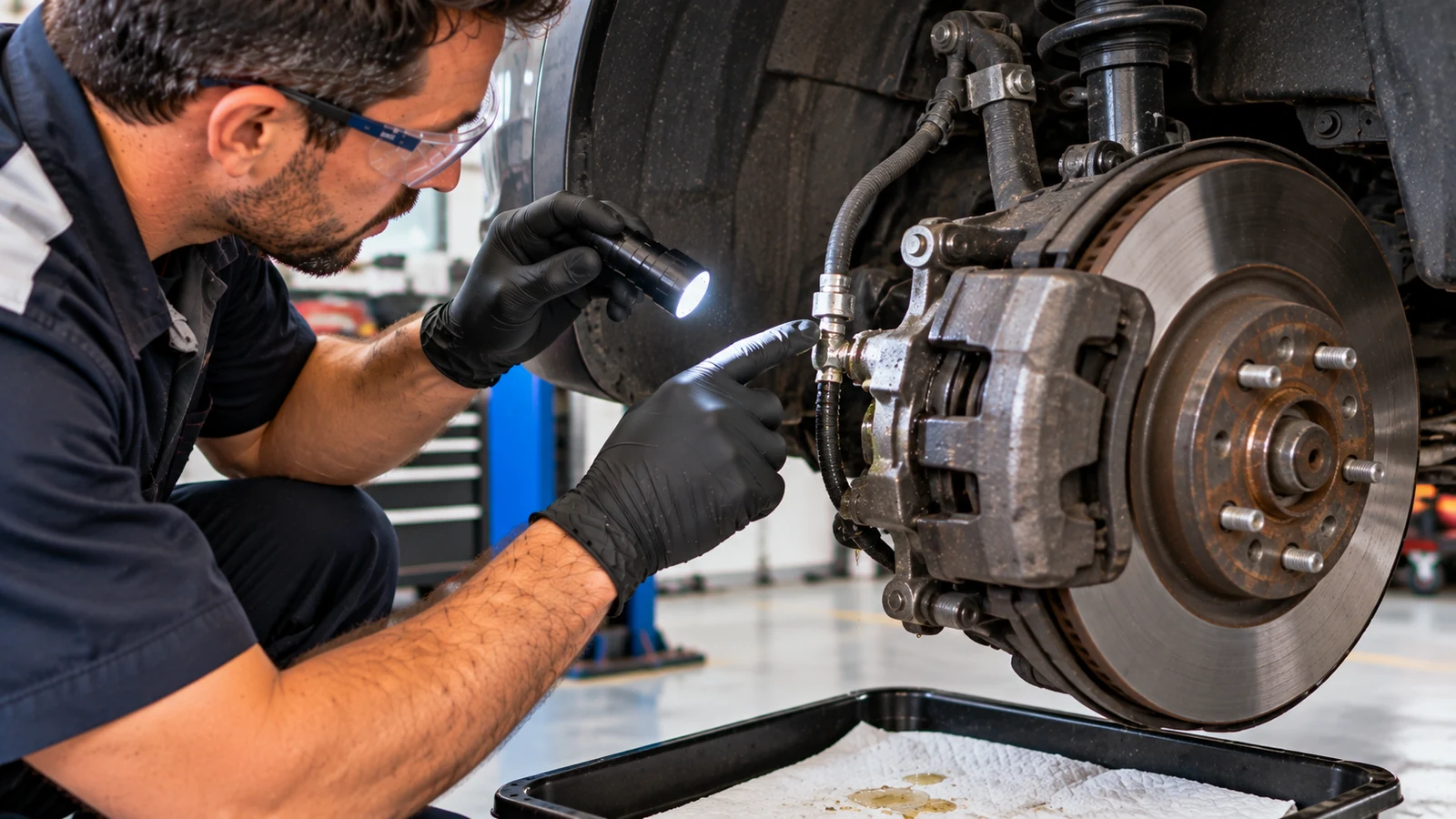
Most commonly used DOT 3, DOT 4, and DOT 5.1 brake fluids begin clear to pale amber and darken as they age. Brake fluid is thinner than engine oil but still feels slippery.
Common leak locations include:
- Inside a wheel near a caliper or wheel cylinder.
- Flexible brake hoses.
- Steel brake pipes underneath the vehicle.
- Master-cylinder area near the firewall.
A brake-fluid leak is not a monitor-and-see problem.
Because the braking system relies on hydraulic pressure, fluid loss can cause a soft pedal, sinking pedal, warning light, or reduced stopping ability. If you confirm brake fluid is leaking, do not drive the vehicle.
Workshop documentation is especially important when repairing calipers, brake hoses, master cylinders, or hydraulic clutch components because bleeding sequences and tightening specifications differ.
For Honda applications, AutoServicePlus provides Honda workshop manuals and model-specific information such as the 2006–2012 Honda Civic workshop manual.
Likewise, Nissan workshop manuals provide model-specific hydraulic brake information, while the 2002–2012 Nissan-Datsun Altima workshop manual covers matching Altima applications.
Manual-Transmission Clutch Systems Can Use The Same Fluid
Many hydraulic clutch systems use brake fluid.
A clutch hydraulic leak may appear:
- Around the clutch master cylinder.
- Under the dashboard near the clutch pedal.
- Around an external slave cylinder.
- Near the transmission bellhousing if the slave cylinder is internal.
The clutch pedal may feel soft, fail to return normally, or become difficult to disengage.
Thick Amber or Brown Leaks: Gear and Differential Oil
Gear oil is typically thicker than engine oil and has one of the easiest automotive-fluid smells to recognize: a strong sulfur or rotten-egg odor from its extreme-pressure additives.
It is used in components such as:
- Differentials.
- Transfer cases on many 4WD/AWD systems.
- Some manual transmissions.
- Axle assemblies.
The puddle location often identifies the component.
A leak at the rear center can come from a differential cover, drain plug, or pinion seal. Oil near the inner side of a wheel may indicate an axle seal leak. A leak behind the transmission may come from the transfer case.
For four-wheel-drive service, Jeep workshop manuals provide vehicle-specific driveline procedures. Matching examples in the supplied inventory include the 2005–2014 Jeep Grand Cherokee 4WD workshop manual and the 1987–2006 Jeep Wrangler workshop manual.
Truck differentials and transfer cases also require the correct lubricant and fill procedure. AutoServicePlus also lists Ram workshop manuals, including the 2009–2013 RAM 1500 4WD workshop manual.
AWD vehicles may have additional driveline components and seals to inspect. The Volvo workshop manual library provides manufacturer-specific information, including a 2004–2013 Volvo XC90 AWD workshop manual for matching vehicles.
Low differential or transfer-case oil can eventually cause whining, humming, overheating, or internal wear, so don’t ignore an active gear-oil leak.
Blue, Green or Pink Watery Leaks: Washer Fluid
Windshield washer fluid is usually thin like water and may be blue, green, pink, or orange. Its alcohol or glass-cleaner smell helps separate it from similarly colored coolant.
Common leak points are:
- Washer reservoir.
- Washer pump seal.
- Small plastic hoses.
- Hose connections.
A washer-fluid leak is not mechanically dangerous to the engine or transmission, but an empty reservoir can become a visibility problem in poor weather.
Because washer fluid can contain methanol or other chemicals, handle it carefully.
Clear and Odorless Drips: Usually Water
One of the most common harmless puddles appears after running the air conditioner.
As the A/C evaporator cools cabin air, moisture condenses and drains through a tube beneath the vehicle. The resulting drip is normally:
- Completely clear.
- Odorless.
- Watery.
- Free of oily residue.
- Located near the firewall, often toward the passenger side.
A small amount of water at the exhaust tailpipe is also normal because water vapor is a combustion byproduct and can condense inside a cold exhaust.
Clear Does Not Automatically Mean Harmless
Investigate further if the fluid:
- Smells strongly of gasoline.
- Feels slippery and appears near a wheel.
- Leaves oily residue near an A/C fitting.
- Has a sweet odor.
- Appears inside the passenger compartment rather than draining beneath the vehicle.
Color must always be combined with the other clues.
Fuel and DEF Leaks: Recognizing High-Risk Fluids
Gasoline Leaks Require Immediate Action
Gasoline is clear to pale amber, extremely thin, and evaporates quickly. Its strong odor usually identifies it before color does.
Possible sources include:
- Fuel tank.
- Filler neck.
- Fuel lines.
- Fuel rail.
- Injector seals.
- Connections around the fuel pump.
If gasoline is actively leaking, do not start the engine. Keep sparks and flames away, and arrange to have the vehicle transported for repair.
Fuel systems can remain pressurized after the engine is switched off, so follow service procedures before opening the system.
Diesel Feels Oilier and Evaporates Slowly
Diesel has a heavier, greasy smell and leaves a persistent oily patch. A diesel leak may come from the tank, lines, filter housing, injection equipment, or associated connections.
The NXT source uses the Hyundai Tucson as an example of why exact powertrain identification matters, noting that the referenced JM-generation service information covers both gasoline and diesel applications.
AutoServicePlus provides Hyundai workshop manuals and a matching 2005–2010 Hyundai Tucson JM workshop manual for vehicle-specific fuel-system and service procedures.
DEF Leaves A Distinctive Dry Residue
Diesel exhaust fluid, also called DEF or AdBlue in many markets, is watery and can have a faint ammonia-like smell.
Its most useful visual clue appears after it dries: white crystalline deposits around the leaking fitting, line, tank, or dosing component.
DEF is not engine coolant or fuel, so the correct repair starts with identifying the SCR/DEF system rather than treating the deposits as ordinary coolant residue.
Smells Without a Puddle Can Still Reveal a Leak
Not every fluid reaches the ground. A small amount may land on a hot exhaust component and evaporate or burn before forming a puddle.
| Smell | Possible source | Useful first check |
|---|---|---|
| Sweet | Coolant | Coolant level, hoses, heater area |
| Heavy burnt oil | Engine oil on hot exhaust | Valve cover and upper-engine area |
| Acrid burnt petroleum | Overheated transmission fluid | Transmission level and condition |
| Raw gasoline | Fuel or vapor leak | Fuel lines, injector area, filler system |
| Heavy diesel odor | Diesel leak | Filter, injectors, lines, underside |
| Sulfur/rotten eggs | Gear oil, battery issue, exhaust issue | Driveline, battery, catalytic area |
| Ammonia | DEF | DEF tank, lines, dosing equipment |
| Alcohol/glass cleaner | Washer fluid | Washer reservoir and hoses |
| Musty/damp | A/C moisture problem | Evaporator drain and cabin filter area |
Battery problems deserve separate caution. White or blue-green corrosion around a lead-acid battery is different from an ordinary automotive fluid leak. A strong sulfur smell near the battery can indicate a charging or battery fault and should be investigated without creating sparks nearby.
Hybrid and Electric Vehicle Leak Identification
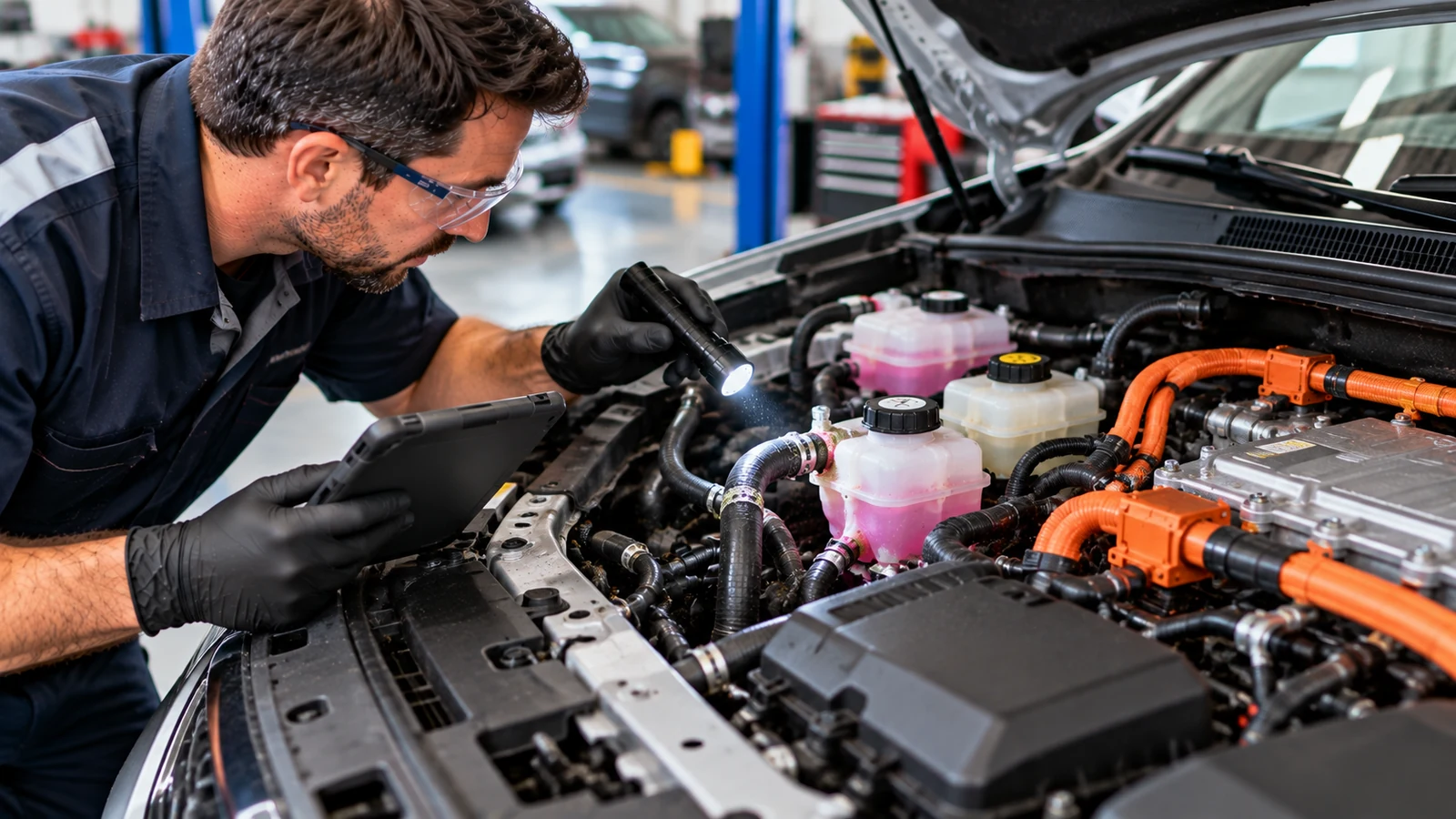
Hybrid vehicles can carry conventional engine fluids plus additional cooling circuits for power electronics. Battery-electric vehicles do not have engine oil, but they can still use:
- Brake fluid.
- Washer fluid.
- A/C refrigerant and compressor oil.
- Drive-unit lubricant.
- Battery and electronics coolant.
The same color, smell, texture, and location method still helps, but high-voltage safety changes the repair procedure.
Do not assume an unidentified coolant leak around a hybrid belongs to the engine circuit. Identify the actual reservoir and cooling loop first.
For Toyota hybrids, the 2010–2013 Toyota Prius factory workshop manual provides model-specific system information for matching vehicles.
AutoServicePlus also supplies Ford workshop manuals. The 2005–2008 Ford Escape 4WD workshop manual is relevant to the source’s Escape example, while the 2013 Ford Fusion FWD Hybrid workshop manual provides hybrid-specific service coverage for a different Ford platform.
Honda hybrid service should likewise follow hybrid-specific information rather than a conventional-engine procedure. The supplied inventory includes a 2020–2022 Honda CR-V Hybrid workshop manual.
Never work around orange high-voltage cables or battery-system components without following the manufacturer’s isolation procedure.
How Serious Is the Leak?
The fluid type and the rate of loss both matter.
Stop Driving and Arrange Repair Or Towing
Treat these as urgent:
- Brake fluid leak.
- Active gasoline leak.
- Significant diesel leak.
- Coolant leak accompanied by overheating or steam.
- Engine oil leak accompanied by an oil-pressure warning.
- Any leak with smoke, fire, or electrical burning.
- A rapidly spreading puddle from an unidentified system.
Repair Soon and Monitor The Level
These may allow limited driving if the fluid level remains correct and no warning signs are present:
- Small engine-oil seep.
- Slow coolant seep with normal temperature.
- Minor transmission-fluid leak.
- Power-steering fluid leak on a hydraulic system.
- Differential or transfer-case leak.
- DEF leak.
The purpose of monitoring is to reach repair safely, not to postpone the repair indefinitely.
Usually Normal or Low Urgency
These include:
- Clear A/C condensation.
- Tailpipe water.
- Minor windshield-washer fluid leak.
Confirm the Source Before Buying Parts
Fluid identification tells you the system involved. It doesn’t always tell you which seal, hose, gasket, or component failed.
Clean The Area and Look For The First Fresh Wet Point
Old residue can make a component below the real leak look guilty.
With the engine cold:
- Clean the suspect area.
- Allow it to dry.
- Operate the vehicle normally.
- Inspect again.
- Follow the fresh wet trail upward and forward.
- Compare the leaking fluid with fluid from the suspected system.
The highest fresh wet point is usually closer to the actual source.
Use The White Cardboard Test Overnight
Park on level ground and place clean white cardboard beneath the vehicle.
Mark where the front wheels and bumper sit so you can relate each spot back to the vehicle the next morning.
This makes it easier to identify:
- Number of separate leaks.
- Approximate location.
- Fluid color.
- Rate of loss.
Use Pressure Testing or The Correct UV Dye When Appropriate
Cooling-system pressure testing can expose slow coolant leaks while the engine is cold.
UV dye can help with some oil, coolant, A/C, and other system leaks, but use dye intended for that particular fluid and system.
When the source is difficult to access, model-specific diagrams can prevent unnecessary disassembly. Land Rover workshop manuals provide system layouts and repair procedures, while the 2015–2017 Land Rover Discovery Sport workshop manual is a vehicle-specific example available in the supplied AutoServicePlus inventory.
Why Vehicle-Specific Workshop Data Matters

Identifying the fluid is only half the repair.
A workshop manual becomes important when you need to confirm:
- Exact fluid specification.
- Fluid capacity.
- Correct checking temperature.
- Drain and fill plug locations.
- Tightening torque.
- Sealant requirements.
- Gasket orientation.
- Cooling-system bleeding sequence.
- Brake or clutch bleeding procedure.
- Fuel-system pressure-relief steps.
- Component removal sequence.
- Differential or transfer-case fill procedure.
- Hybrid shutdown requirements.
Two vehicles can use fluids of similar color while requiring completely different specifications.
Likewise, two generations of the same model may use different engines, transmissions, steering systems, or AWD hardware. The AutoServicePlus URL inventory contains thousands of separate factory workshop manual pages because those differences matter during repair.
Use the manual that matches the actual model, year, powertrain, and drivetrain rather than choosing fluid or torque data from a visually similar vehicle.
Conclusion
To identify a car leak by color and smell, do not rely on one characteristic. Compare the fluid’s color, odor, texture, and location, then check the corresponding system.
Sweet and watery points toward coolant. Dark and slick usually suggests engine oil. Red oily fluid may be transmission or steering fluid. Thin clear-to-amber fluid near a wheel may be brake fluid. Thick lubricant with a sulfur smell points toward a differential or gearbox. Clear, odorless water after running the A/C is usually normal.
Once you know which system is leaking, confirm the exact source before ordering parts. Clean and recheck the area, use pressure testing or appropriate UV dye where useful, and follow vehicle-specific workshop information for fluid specifications, torque values, bleeding procedures, and component removal.
Correctly identifying the fluid tells you where to start. Confirming the source and using the right repair data prevents the same leak from returning.
Commonly Asked Questions About Identifying Car Fluid Leaks by Color and Smell
Is Clear Water Dripping Under My Car Normal?
Usually, yes, if the air conditioner has been running.
A/C condensation is clear, odorless, and watery, usually appearing near the firewall. Water from the tailpipe can also be normal.
Investigate if the clear liquid smells of gasoline, feels oily or slippery, or has a sweet smell.
How Do I Tell Engine Oil From Transmission Fluid?
Engine oil is usually amber when fresh and brown or black after use. Automatic transmission fluid is commonly red or pink when fresh and can become brown with age.
Location helps. Oil usually appears below the engine, while transmission fluid is more likely around the transmission, pan, cooler lines, or engine-to-transmission area.
How Can I Distinguish Coolant From Washer Fluid?
Both can be brightly colored and watery.
Coolant normally smells sweet and feels slightly slippery. Washer fluid generally smells like alcohol or glass cleaner.
Also check where the leak appears. Washer reservoirs are often near a front corner of the engine bay, while coolant can leak from several points throughout the cooling system.
What Fluid Smells Like Rotten Eggs?
Thick amber or brown fluid with a strong sulfur smell is commonly gear or differential oil.
If there is no fluid puddle and the smell is strongest around the battery, investigate the battery and charging system. A sulfur smell from the exhaust is a separate issue.
Can I Drive With an Oil Leak?
A very small seep may allow limited driving if the oil level remains correct and there is no oil-pressure warning.
If the leak is fast, the oil level is low, you see visible smoke from oil reaching the exhaust, or the oil-pressure warning comes on, you should switch off the engine.
Can I Drive With A Coolant Leak?
It depends on the severity, but coolant leaks can become dangerous quickly.
If the temperature is rising, steam is visible, or coolant is escaping rapidly, stop driving. A slow seep with a stable temperature still needs repair because the system can eventually lose enough coolant to overheat.
Can I Drive With A Transmission-Fluid Leak?
A small leak may not cause an immediate symptom, but low transmission fluid can lead to poor lubrication, delayed engagement, slipping, or internal damage.
Check the level using the vehicle’s specified procedure and repair the leak promptly.
Is Any Brake-Fluid Leak Safe to Drive With?
No confirmed brake-fluid leak should be treated as safe.
The hydraulic system relies on fluid pressure to operate the brakes. Fluid loss can reduce braking performance without much warning.
Why Does My Car Smell Like Burning Oil But Leave No Puddle?
Oil may be leaking onto a hot exhaust component and burning before it reaches the ground.
Inspect the upper engine for wet areas around valve covers, oil housings, and nearby seals.
Why Is There A Puddle But All My Fluid Levels Look Normal?
The puddle may be harmless A/C condensation, or the leak may be too slow to create an obvious level change yet.
Some transmissions and driveline components also require special checks beyond a simple dipstick reading.
Use clean cardboard for several nights and monitor the appropriate fluid correctly.