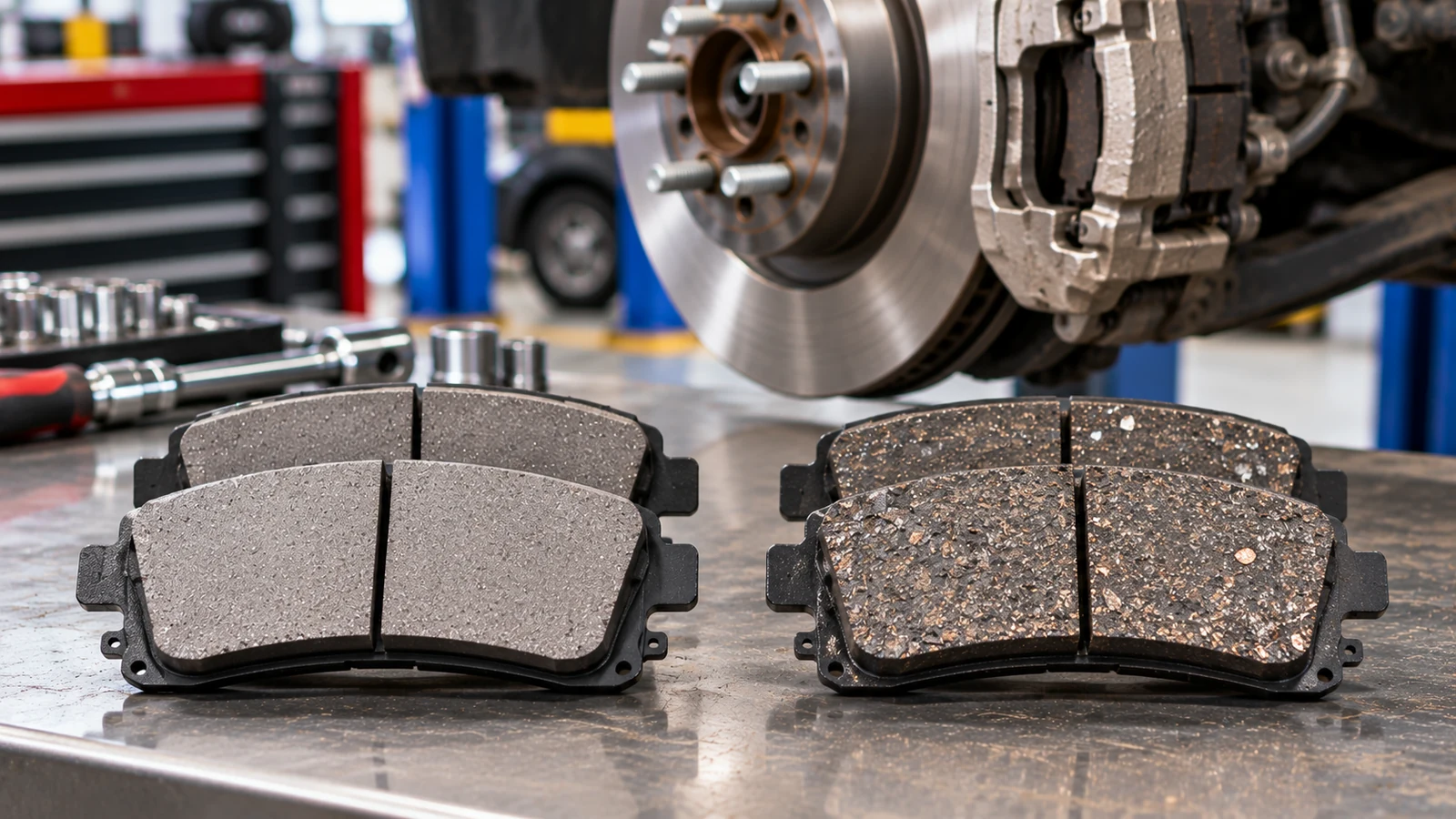
Choosing between ceramic and semi-metallic brake pads is not just a question of which material is “better.” The right choice depends on the vehicle, the loads it carries, the temperatures the brakes see, how much stop-and-go driving you do, and the brake system specification the manufacturer designed around.
For most normal commuting, ceramic pads are attractive because they are generally quiet, create lighter dust, and tend to be easier on rotors. Semi-metallic pads trade some of that refinement for stronger initial bite and better heat handling during repeated hard stops, towing, hauling, or demanding driving. The important point is that pad material should match the job the brakes actually perform.
A brake pad change is also a service decision, not just a parts decision. Rotor condition, caliper hardware, brake fluid, bedding procedure, and the factory specification can matter as much as the compound printed on the pad box.
Key Takeaways
- Ceramic brake pads generally fit quiet, low-dust daily driving and tend to be gentler on rotors.
- Semi-metallic brake pads generally fit towing, hauling, repeated hard braking, and drivers who want stronger initial bite.
- Neither material is automatically correct for every vehicle. The manufacturer’s brake specification and how you use the vehicle should determine the final choice.
- Hybrids and EVs need a slightly different brake-service mindset because regenerative braking can leave the friction brakes unused for long periods, increasing the importance of corrosion, glazing, and free-moving caliper hardware.
- Switching pad compounds is possible, but replace pads as matched axle sets, check rotors, and follow the correct bedding and service procedure.
Start With Driving Conditions, Not Pad Marketing
Brake pads work by pressing friction material against the rotor and converting vehicle motion into heat. That means the best material depends heavily on how much heat the system must absorb and how often it must do it.
A commuter car making ordinary city and highway stops has a different brake duty cycle from a loaded pickup descending a long grade. A performance car that repeatedly slows from higher speeds is different again. This is why a material that feels excellent in one application can be noisy, dusty, expensive, or thermally limited in another.
| Driving situation | Common starting point | Main reason |
| Daily commuting and family use | Ceramic | Quiet operation, lighter dust, smooth normal braking |
| Frequent towing or hauling | Semi-metallic | Better heat dissipation and stronger bite |
| Repeated hard or performance braking | Semi-metallic | Greater thermal margin during repeated stops |
| Mixed normal and occasional demanding use | Hybrid pad may be worth considering | Attempts to balance refinement and heat handling |
| Hybrid or EV use | Follow the vehicle specification first | Regenerative braking changes how often friction brakes work |
These are general tendencies, not replacement specifications. Always check the service information for the exact vehicle before changing from the material type it was designed to use.
What Ceramic and Semi-Metallic Pads Actually Change
Ceramic and semi-metallic brake pads differ in friction material, braking feel, noise, dust, heat handling, and rotor wear. Understanding these differences helps you choose a pad compound that matches your vehicle, driving conditions, and braking needs.
Ceramic Brake Pads Favor Refinement and Low Dust
Ceramic pads use dense ceramic fibers with fine copper in the friction mix. In normal driving, they are known for quiet operation, light-colored dust, relatively gentle rotor wear, and good service life for commuting.
Their main trade-offs are cost and demanding heat use. Ceramic pads usually cost more upfront and can give up some braking performance during continuous hard braking in extreme heat. They also tend to feel less aggressive on first touch than semi-metallic pads.
For a vehicle that spends most of its life commuting, carrying normal loads, and making routine stops, those trade-offs may be acceptable. For a vehicle that tows or repeatedly brakes hard, they may matter more.
Semi-Metallic Brake Pads Favor Bite and Heat Control
Semi-metallic pads typically contain roughly 30 to 70 percent metal, commonly including steel, copper, and iron along with friction modifiers and graphite lubricants.
That construction helps the pad transfer and dissipate heat. Semi-metallic pads also tend to provide stronger initial grip, including in cold or wet conditions. Those traits explain why they are commonly associated with heavy loads, towing, and performance use.
The compromise is refinement. Semi-metallic pads are more likely to create dark brake dust, make more noise, and wear rotors faster because the friction material is more abrasive.
Hybrid And Organic Pads are Alternatives, Not Automatic Upgrades
Parts catalogs may also list hybrid and organic friction materials. Hybrid pads are intended to combine some ceramic refinement with some semi-metallic heat capacity.
Organic, or non-asbestos organic, pads use softer materials such as fibers, rubber, glass, and resin. They can be quiet, but they generally wear faster and suit lighter-duty use.
If the original vehicle specification calls for something else, treat a different compound as a compatibility decision, not an automatic upgrade.
Compare Ceramic Vs. Semi-Metallic Pads By Real Service Factors
| Service factor | Ceramic pads | Semi-metallic pads |
| Noise | Usually quieter in normal use | More likely to squeal or sound harsh |
| Brake dust | Lighter and less visible | Darker and more noticeable |
| Rotor wear | Generally gentler | Generally more abrasive |
| Initial bite | Smoother, less aggressive feel | Stronger initial response |
| Heat handling | Well suited to normal driving | Better for repeated high-heat stops |
| Towing and heavy loads | Usually not the first general choice | Commonly favored |
| Upfront pad cost | Usually higher | Usually lower |
| Normal commuting life | Often strong | Durable, but designed more around demanding use |
These are general material tendencies. Actual performance still varies by pad formulation and the vehicle it is fitted to.
Noise and Dust are Only Partly About Pad Material
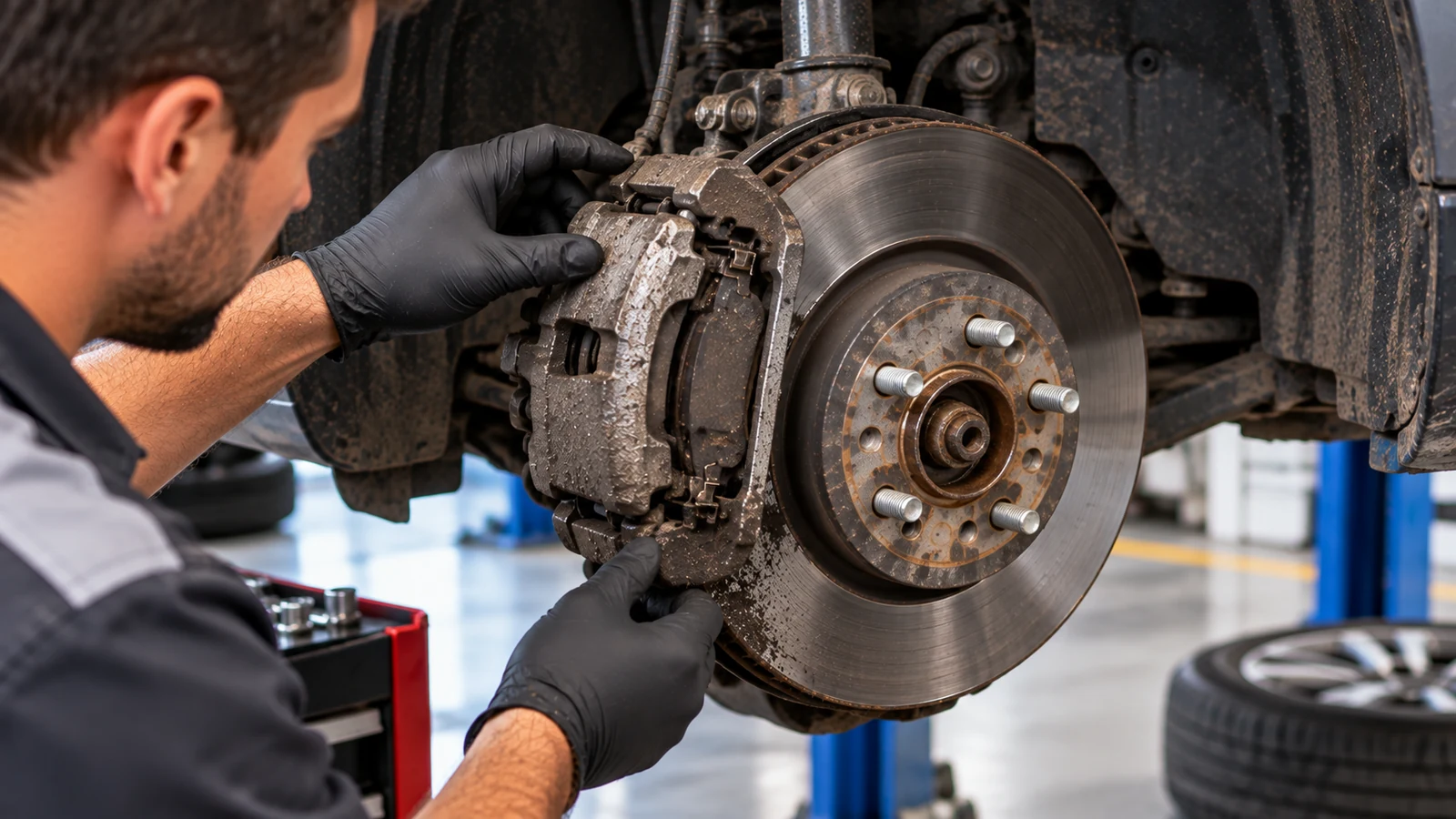
Drivers often choose ceramic pads for cleaner wheels and less noise. That is a reasonable use case, but a quiet compound will not fix a poor installation.
Brake squeal after a pad change can come from rust or debris in the bracket channels, missing or damaged shims, dry contact points, sticking guide pins, or a skipped bedding procedure. Grinding is more serious because it can indicate the friction material has worn far enough that the backing plate is contacting the rotor.
So if a brake is noisy, diagnose the system before assuming a different compound will solve it.
Heat and Brake Fade Matter Most Under Sustained Braking
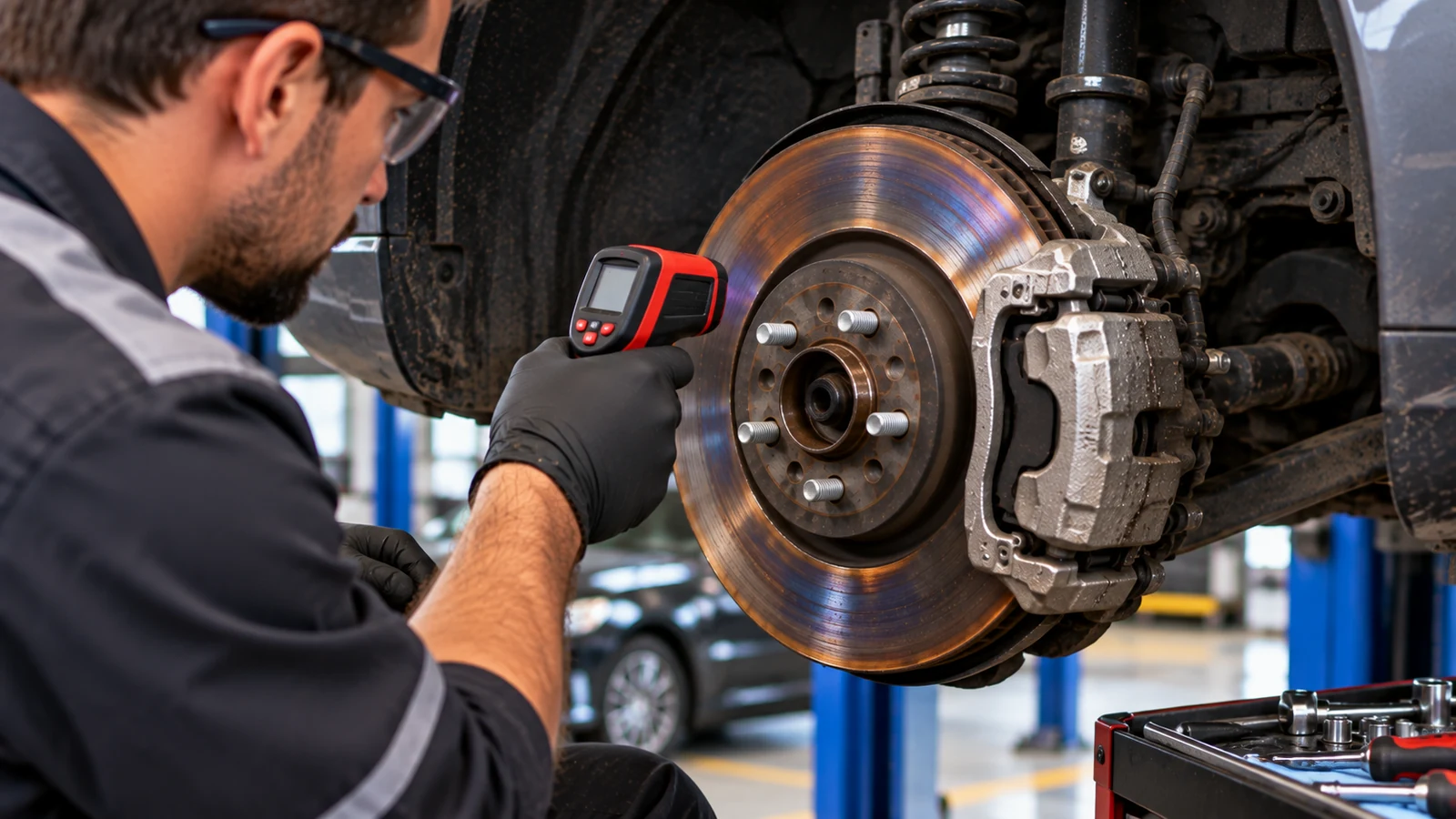
Every stop converts kinetic energy into heat. Under normal driving, both pad types can work well when they fit the vehicle. The difference becomes more important when heat keeps building.
Semi-metallic pads generally move heat away better and maintain braking performance through repeated hard stops. That makes them a common starting point for towing, hauling, long descents, and performance driving. Ceramic pads usually focus more on refinement and normal road use.
The pad is only one part of that heat system. Worn rotors, moisture-contaminated brake fluid, dragging calipers, or poor driving technique can still cause fade or overheating even if you install a heat-tolerant pad.
Rotor Wear Changes the Real Cost of A Brake Job
Pad price alone can be misleading. Ceramic pads usually cost more, but their lower abrasiveness can help rotors last longer. Semi-metallic pads may cost less initially but can contribute to faster rotor wear.
That is why rotor inspection belongs in every pad decision. Measure rotor thickness against the stamped minimum or the factory specification, inspect both friction surfaces, and look for heavy scoring, heat damage, or uneven wear. If the rotor is already near its minimum thickness, the cheapest pad set may not produce the cheapest overall repair.
Check the Brake System Before Changing Pad Material
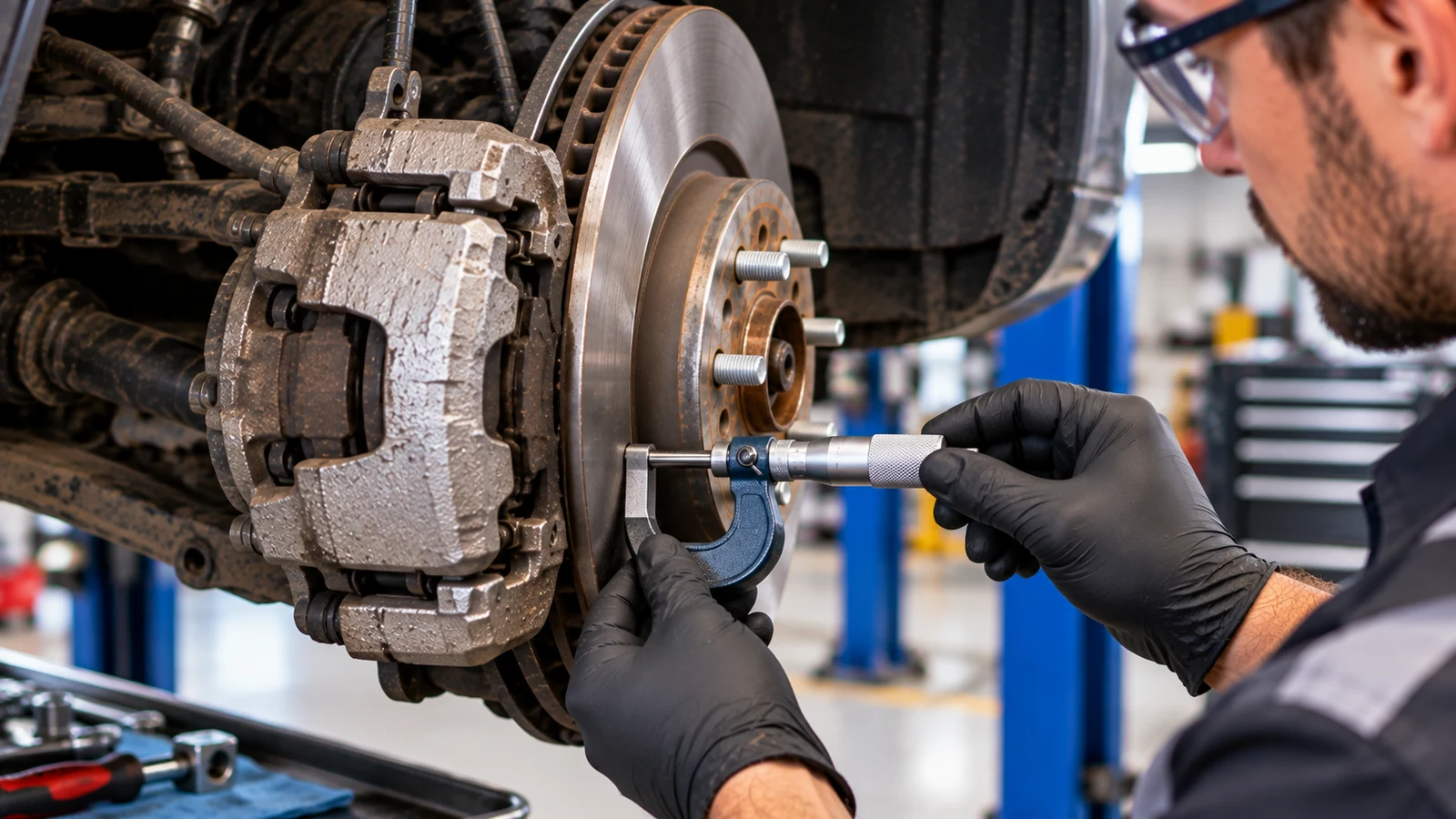
Before buying a different compound, inspect the parts that determine how well any pad can work.
- Check rotor thickness and condition. A new pad cannot correct an undersize, badly scored, or severely heat-damaged rotor.
- Check caliper slides and pad hardware. Pads must move freely in the bracket, and the caliper must release correctly.
- Check brake fluid condition. A soft or spongy pedal under heat is not a friction-material problem.
- Check for uneven pad wear. One pad wearing much faster than its mate can point to a sticking caliper, a seized slide, or a hardware issue.
- Confirm front and rear specifications separately. Many vehicles use different pad sizes or friction requirements at each axle.
- Check electronic parking brake procedures where fitted. Rear brake service on some vehicles requires a specified service mode rather than simply forcing the piston back.
A vehicle-specific workshop manual is especially useful for the last three items because torque values, component arrangement, rotor limits, and electronic procedures vary by model.
Which Pad Type Fits Different Vehicles and Driving Profiles?
The right brake pad depends on the vehicle, load, driving conditions, and braking demands. Daily commuters, heavy-duty vehicles, performance cars, and hybrids or EVs can have different friction-material requirements, so always verify the vehicle-specific brake specification before choosing a pad type.
Daily Commuting and Family Vehicles
For ordinary commuting, ceramic pads are usually the first material most owners consider because low noise and light dust matter more than maximum thermal capacity. The final choice should still match the original brake specification.
For example, the 2015 Toyota Camry XV50 workshop manual can help a technician confirm model-specific brake service information before fitting pads. AutoServicePlus also has a broader Toyota service manual library for other Toyota applications.
The same approach applies to cars such as the 2016-2018 Honda Civic FC/FK and the 2010-2019 Volkswagen Jetta Mk6. If the exact year or platform differs, use the wider Honda workshop manual collection or Volkswagen repair manual catalog rather than assuming the same brake specification carries across generations.
The key service lesson is simple: a daily-driven sedan or hatchback may benefit from ceramic refinement, but the model-specific manual should confirm the system details before ordering parts.
Towing, Heavy Pickups, SUVs, and Loaded Vehicles
Vehicles that regularly tow or carry heavy loads generate more heat during braking. Semi-metallic pads are commonly favored in this use because their heat transfer and initial bite suit repeated high-load stops.
For pickup applications, AutoServicePlus includes model-specific information for the 2003-2013 GMC Sierra Denali AWD, the 2021 Dodge Ram 1500, and the 2000-2013 Ford F-350 4WD Super Duty. Broader coverage is available through the GMC manuals, Ram service manual library, and Ford repair manual collection.
Large SUVs can create similar demands, especially when fully loaded or used for trailer work. The 2014-2018 Chevrolet Tahoe and Suburban manual is a useful example, with more applications in the Chevrolet workshop manual library.
SUV use is not automatically the same as towing, though. A crossover used for school runs has a different thermal load from a vehicle pulling a trailer through hills. The supplied AutoServicePlus inventory also includes the 2003 Volvo XC90 2.5T AWD manual, the 2015-2017 Land Rover Discovery Sport L550 manual, and the 2019-2020 SsangYong Tivoli X150 manual as examples of why the exact model and use case matter more than body style alone.
Performance and Repeated Hard Braking
Repeated hard braking quickly raises pad and rotor temperature, so thermal capacity becomes more important than quiet operation or wheel cleanliness. Semi-metallic pads are often the best starting point for this kind of use, as long as they’re compatible with the vehicle.
The AutoServicePlus inventory includes performance-oriented examples such as the 2013 Audi S6 Quattro 4G2 manual, 2002 BMW Z4 E85 manual, and 2012-2016 Porsche Boxster/Cayman 981 manual. Their broader manufacturer libraries are available under Audi factory workshop manuals, BMW repair manuals, and Porsche workshop manuals.
Other examples in the supplied sheet include the 2014 Dodge Charger LD manual and 2008-2012 Volkswagen Golf Mk6 GTI manual.
Pad material is only part of a performance brake setup, so check rotor and brake-fluid condition at the same time.
Hybrids and EVs Need Attention to Corrosion and Hardware
Hybrids and electric vehicles use regenerative braking to slow the vehicle without relying on the friction brakes for every deceleration. That can reduce pad wear, but it can also mean the discs and caliper hardware spend more time sitting relatively unused. Rust, glazing, uneven wear, and sticking hardware therefore become important service concerns.
This is where the factory procedure matters more than a general ceramic-versus-metallic rule. AutoServicePlus carries model-specific manuals for the 2014-2015 Hyundai Sonata Hybrid FY HEV, 2020-2022 Honda CR-V Hybrid, and 2014-2018 Ford C-MAX Hybrid. For more Hyundai applications, the Hyundai workshop manual library provides additional model coverage.
Battery-electric examples in the supplied inventory include the 2017+ Chevrolet Bolt EV, 2011-2013 Nissan-Datsun Leaf, 2019-2022 MG ZS EV, and 2015-2019 Kia Soul EV/e-Soul. Useful manufacturer-level coverage is also available through the Nissan repair manual library and MG workshop manual collection.
The 2016 Subaru Crosstrek Hybrid manual is another example of why hybrid brake servicing should follow vehicle-specific procedures. On some electrified vehicles, hydraulic bleeding or brake actuator work can require scanner-controlled steps rather than a conventional pump-and-hold method.
Can You Switch From Semi-Metallic to Ceramic Pads?
Switching from one friction-material family to another is possible when the replacement pad is compatible with the vehicle and doesn’t conflict with the manufacturer’s requirements.
Before switching:
- Confirm the pad specification for the exact axle. Front and rear brakes can use different pad shapes, sizes, or friction requirements.
- Replace pads as a matched axle set. Do not fit different compounds left to right on the same axle.
- Inspect the rotors. A heavily worn or badly scored rotor can prevent the new pad from bedding correctly.
- Clean and service the hardware. Bracket channels, shims, clips, and slide pins need to move and seat correctly.
- Use the correct lubricant only at approved contact points. Keep grease off the pad faces and rotor surfaces.
- Follow the pad maker’s bedding procedure. Different compounds can require different heat cycles.
- Recheck pedal feel and noise after the first drives. Do not use a material change to mask a hydraulic, caliper, or rotor fault.
Changing compounds is not a shortcut around brake-system diagnosis. If the vehicle already has uneven wear, a soft pedal, pulsation, or a sticking caliper, fix that fault first.
Installation and Bedding Matter as Much as Pad Material
A good pad installed badly can perform worse than an ordinary pad installed correctly. That is why brake service should include the hardware and mating surfaces, not just the friction material.
During installation, clean rust and debris from the pad channels, inspect guide pins and boots, fit required clips or shims, and torque fasteners to the model-specific value. If the vehicle uses an electronic parking brake, confirm the service-mode procedure before retracting the rear caliper mechanism.
Bedding is the controlled process that establishes an even transfer layer of friction material on the rotor. Ceramic and semi-metallic pads can use different bedding routines, so follow the procedure supplied with the pad set and the vehicle-specific service information. Skipping bedding can contribute to noise, uneven feel, and poor initial performance.
Use the Workshop Manual to Confirm the Details That Parts Catalogs Miss Technician checks brake specifications in workshop manual
A parts catalog can tell you that a pad fits. A factory-style workshop manual can tell you how the brake system is meant to be serviced.
Before a brake job, use model-specific repair information to confirm:
- minimum rotor thickness and inspection limits;
- caliper and bracket fastener torque;
- pad hardware and shim arrangement;
- guide-pin lubrication points;
- electronic parking brake service procedures;
- brake-fluid bleeding sequence;
- component removal order;
- warnings related to hybrid or EV brake actuators.
This is especially important when two vehicles share a model name across multiple generations. Brake hardware, rotor dimensions, caliper design, electronic controls, and service procedures can change even when the badge stays the same.
Warning Signs That the Problem Is More Than Pad Material
Choosing ceramic or semi-metallic pads won’t fix a brake fault that originates elsewhere in the system. Diagnose these symptoms before buying pads:
- Harsh grinding: Friction material may be worn through, allowing the backing plate to contact the rotor.
- Steering-wheel or pedal pulsation: Rotor problems or heat damage may be involved.
- Soft or spongy pedal: Look for hydraulic problems, air, fluid condition, or leaks rather than blaming the pad compound.
- One wheel running unusually hot: A sticking caliper, seized slide, or parking-brake issue may be keeping the brake applied.
- Uneven inner and outer pad wear: Caliper movement or hardware may be restricted.
- Brake or ABS warning lights: Electronic or hydraulic diagnosis should come before friction-material replacement.
- New pads wearing quickly: Check rotor condition, caliper drag, or incorrect installation.
Around 3 mm of remaining friction material is a common warning point for pad replacement, but always compare actual wear with the applicable service information.
Brake Pad Selection Checklist
Use this sequence before ordering parts:
- Identify the factory pad specification for the exact year, model, brake package, and axle.
- Describe how the vehicle is actually used. Daily commuting, towing, heavy cargo, mountain driving, performance use, hybrid driving, and long storage periods create different needs.
- Inspect the rotors and hardware before assuming pads are the only required parts.
- Choose the friction material that fits the duty cycle. Ceramic generally favors quiet daily use; semi-metallic generally favors heat, load, and aggressive braking.
- Check total service cost, not pad price alone. Include rotor condition, hardware, labor, and expected wear.
- Install matched pads across the axle and service the caliper hardware correctly.
- Bed the pads according to the supplied procedure and verify normal pedal feel and release afterward.
Conclusion
Ceramic vs. semi-metallic brake pads is a trade-off question, not a universal ranking. Ceramic pads generally make the most sense when quiet operation, low visible dust, smooth everyday braking, and lower rotor wear are priorities. Semi-metallic pads generally make more sense when the vehicle regularly deals with heavy loads, towing, repeated hard stops, or sustained heat.
Before changing compounds, verify the factory recommendation, inspect the rotors and caliper hardware, confirm the procedure for the exact vehicle, and install the new pads as a matched axle set. Choosing the right material helps, but correct diagnosis and correct service are what make the brake system work properly.
Frequently Asked Questions
Are Ceramic Brake Pads Better for Everyday Driving?
For many commuting and family-car applications, ceramic pads are an attractive choice because they are generally quieter, create lighter dust, and are gentler on rotors.
They aren’t automatically right for every vehicle, so check the manufacturer’s specifications before changing materials.
Do Semi-Metallic Pads Stop Better than Ceramic Pads?
Semi-metallic pads usually provide stronger initial bite and handle repeated high heat better. That can make them more suitable for towing, hauling, and demanding braking.
Normal stopping performance still depends on the entire brake system, including rotors, fluid, tires, calipers, and the vehicle’s brake-control systems.
Do Ceramic Pads Wear Rotors Faster?
Generally, no. Ceramic material is usually less abrasive, while the harder metallic fibers in semi-metallic pads can contribute to faster rotor wear.
Rotor life still depends heavily on driving conditions, heat, corrosion, rotor condition, and caliper operation.
Can I Replace Semi-Metallic Pads with Ceramic Pads?
Often yes, if the ceramic pad is compatible with the vehicle and the change matches the manufacturer’s requirements and your driving needs.
Replace pads as a full axle set, inspect the rotors, service the hardware, and follow the correct bedding procedure.
Which Brake Pads are Better for Towing?
Semi-metallic pads are commonly the better starting point because they dissipate heat well and maintain stronger braking under heavy loads.
The vehicle manufacturer’s towing-related brake specification should take priority over a general material rule.
Are Ceramic Pads Quieter than Semi-Metallic Pads?
They usually are in normal driving, but pad material is not the only source of brake noise.
Dirty bracket channels, worn hardware, missing shims, dry contact points, rotor problems, or poor bedding can make any pad noisy.
Do Hybrids and EVs Need Special Brake Pads?
Not always. The bigger difference is how you use the friction brakes.
Regenerative braking can leave the pads and rotors idle for long periods, so corrosion, glazing, and sticking hardware deserve more attention. Follow the exact vehicle specification and service procedure.
How Do I Know Which Brake Pad Material My Car Uses?
Start with the owner’s manual for general maintenance guidance and use a vehicle-specific workshop manual for detailed brake specifications, rotor limits, torque values, and procedures.
Parts-catalog fitment is useful, but it should not replace the factory service information for a brake job.